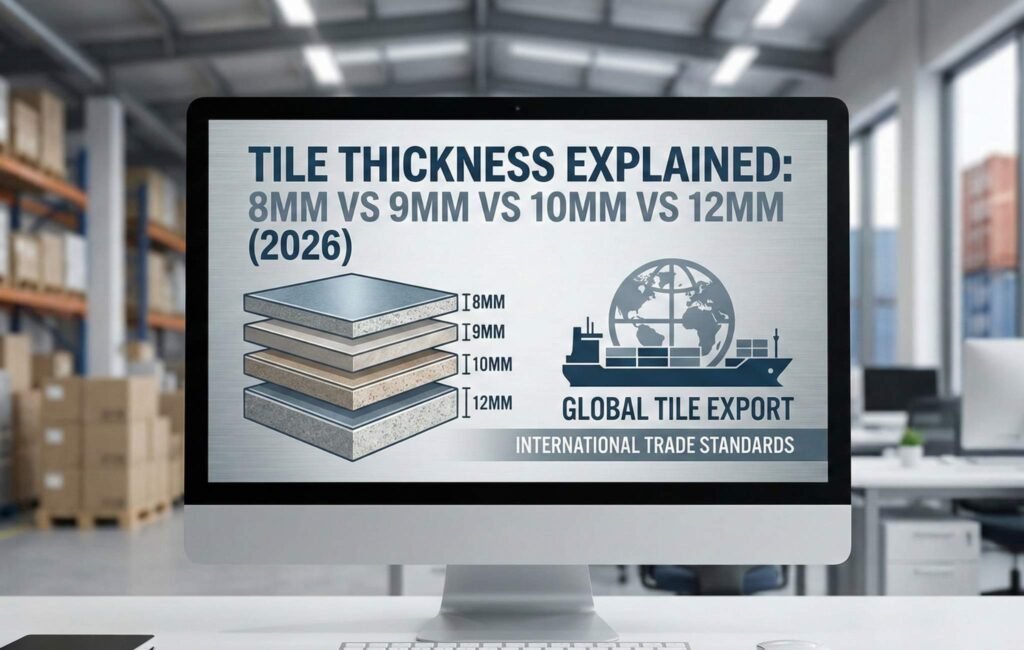
Choosing the right tile thickness goes far beyond aesthetics or basic installation requirements. Tile thickness explained for global buyers: choosing between 8mm, 9mm, 10mm, and 12mm tiles directly affects durability, compliance, shipping safety, and long-term performance in residential and commercial projects.
For importers, distributors, wholesalers, contractors, and project buyers, thickness directly impacts durability, regulatory compliance, shipping efficiency, long-term performance, and commercial risk.
In international trade, incorrect thickness specifications can trigger installation failures, shipment breakage, rejected consignments, or expensive warranty claims. This 2026 guide breaks down 8mm vs 9mm vs 10mm vs 12mm tile thickness from an export, compliance, and performance perspective, helping professional buyers make confident sourcing decisions.
Why Tile Thickness Matters More in Global Trade Than Local Projects
Domestic retail markets often treat tile thickness as a matter of installer preference or budget constraints. International trade demands a more rigorous approach because thickness influences:
- Durability and lifespan under real-world traffic conditions
- Breakage rates during containerized shipping
- Compliance with ISO, ASTM, EN, and CE standards
- Installation success across varied substrates and climates
- Logistics efficiency, including container weight optimization
- Warranty and liability exposure in commercial projects
For exporters and importers, tile thickness must be part of a technical and commercial decision framework, never evaluated in isolation.
This guide addresses the specific needs of B2B buyers sourcing ceramic, porcelain, vitrified, GVT, and PGVT tiles from India for international markets. Read our blog on GVT and PGVT tiles.
Tile Thickness Explained: Global Standards & Applications
How Tile Thickness Is Measured (And Why ±0.5mm Tolerance Matters)
Tile thickness measures the total depth of the tile body, including both the biscuit and glaze layer. Professional buyers should examine not just nominal thickness (such as 9mm or 10mm), but also tolerance control.
- Residential tiles typically require ±0.5mm tolerance
- Commercial tiles may allow ±1.0mm tolerance, depending on the application
- Variations beyond these tolerances can cause:
- Lippage between tiles
- Adhesive failure
- Uneven load distribution
- Installation disputes and claims
Reputable exporters verify thickness consistency during production and conduct final checks before shipment.
Global Thickness Norms by Application
- Wall tiles: 7–8mm
- Residential floor tiles: 9–10mm
- High-traffic residential and light commercial: 10mm
- Commercial flooring: 12mm and above
- Industrial and extreme load areas: 15mm+
Thickness requirements also vary based on climate exposure, traffic intensity, and local building codes. ceramic tile quality inspection
8mm Tiles Explained: Lightweight, Cost-Efficient, Limited Load Capacity
Typical Applications
8mm tiles are designed primarily for vertical applications and low-stress environments:
- Interior wall tiles
- Kitchen backsplashes
- Bathroom walls
- Powder rooms and decorative areas
- Renovation projects with substrate weight limitations
Technical Characteristics
- Lightweight construction
- Easier cutting and handling
- Lower breaking strength compared to thicker tiles
- Faster installation in wall-only applications
Export Buyer Considerations
From an export standpoint, 8mm tiles require careful handling:
- Higher breakage risk during long-distance shipping
- Not recommended for:
- High-traffic flooring
- Commercial environments
- Best used when:
- Wall-only specifications are clearly defined
- Packaging and palletization are optimized
Professional guidance: Never substitute 8mm tiles for floor tiles in cost-driven projects. This commonly leads to post-installation failures.
9mm Tiles Explained: The Global Residential Flooring Standard
Why 9mm Is the Most Exported Thickness Worldwide
9mm tiles represent the most widely accepted thickness for residential flooring across global markets. They deliver a balanced combination of:
- Structural strength
- Installation flexibility
- Shipping efficiency
- Cost-to-performance ratio
Common applications include kitchens, bathrooms, living rooms, and bedrooms.
Performance Profile
- Suitable for moderate foot traffic
- Good impact resistance for residential use
- Compatible with most standard adhesives and substrates
- Efficient container utilization for bulk shipments
When 9mm Tiles Are the Right Choice
- Residential housing projects
- Apartments and villas
- Mid-scale hospitality developments
- Importers targeting volume-driven retail distribution
For many buyers, 9mm tiles represent the lowest-risk, highest-volume thickness category.
10mm Tiles Explained: Premium Residential & Light Commercial Choice
Where 10mm Tiles Outperform Thinner Options
10mm tiles are increasingly specified for areas experiencing higher stress or heavier usage, such as:
- Kitchens and dining areas
- Entryways and hallways
- Furniture-heavy residential spaces
- Bathrooms and wet rooms
Technical Advantages
- Higher modulus of rupture
- Improved impact resistance
- Better performance in damp or temperature-variable environments
- Greater load-bearing capacity
Export & Installation Benefits
- Lower breakage rates during shipping
- Longer service life (typically 15–20 years in residential use)
- Growing demand in premium housing and renovation markets
For importers, 10mm tiles offer a strong balance between durability and logistics efficiency.
12mm Tiles Explained: Commercial-Grade Flooring Standard
Why 12mm Is the Preferred Thickness for Commercial Projects
12mm tiles are classified as commercial-grade flooring and are commonly specified for:
- Offices and corporate spaces
- Hotels and hospitality projects
- Shopping malls and retail centers
- Restaurants and public areas
- Outdoor and semi-outdoor commercial zones
Performance Expectations
- Superior breaking strength
- High impact and abrasion resistance
- Reduced risk of cracking under point loads
- Long-term wear resistance under heavy foot traffic
When Importers Specify 12mm Tiles
- Commercial tenders and institutional projects
- Public infrastructure developments
- High-end residential interiors where longevity is prioritized
Although heavier in shipment, 12mm tiles typically deliver lower total cost of ownership over their lifespan.
8mm vs 9mm vs 10mm vs 12mm: Thickness Comparison by Use Case
Professional buyers don’t compare thicknesses by dimension alone. Instead, they evaluate based on application and performance fit:
- 8mm: Walls and decorative vertical surfaces
- 9mm: Standard residential flooring
- 10mm: High-traffic residential and light commercial
- 12mm: Commercial and heavy-use environments
Common Buyer Mistakes
- Over-specifying thickness, unnecessarily increasing shipping weight
- Under-specifying thickness, leading to breakage or failure claims
- Ignoring climate, traffic, and substrate conditions
Correct thickness selection reduces installation risk, warranty exposure, and long-term maintenance issues.
Tile Thickness, Quality Standards & Compliance (Critical for Importers)
International Standards That Govern Tile Thickness
Tile thickness connects directly to international testing and classification systems, including:
- ISO 13006: Tile classification and performance characteristics
- ISO 10545 series, covering:
- Breaking strength
- Impact resistance
- Frost resistance
- Moisture expansion
Regional Compliance Expectations
- United States: ASTM-aligned performance requirements
- European Union: EN 14411 compliance and CE marking
- Middle East and Asia: Market-specific certifications (SASO, SNI, SIRIM, SONCAP, etc.)
Why Thickness Alone Is Not a Quality Guarantee
Two tiles with identical thickness can perform very differently depending on:
- Water absorption rate
- Firing temperature and kiln control
- Biscuit density and composition
- Glazing and surface treatment
Professional buyers should always evaluate thickness alongside laboratory test reports.
Thickness Impact on Shipping, Breakage & Logistics
Weight & Container Optimization
As thickness increases, so does weight per square meter, which affects:
- Container planning
- Freight efficiency
- Insurance considerations
- Breakage risk during transit
Breakage Risk & Packaging Considerations
Thinner tiles are more vulnerable to:
- Edge chipping
- Micro-cracks
- Damage from vibration during transit
Experienced exporters mitigate these risks through:
- Reinforced palletization
- Edge protection
- Batch-wise packing consistency
How Professional Buyers Choose the Right Tile Thickness
Professional importers follow a specification-driven selection process:
Application → Traffic Level → Environment → Compliance → Logistics
Thickness is evaluated as part of a complete system, not as a standalone feature.
Key Questions Importers Ask Suppliers
- What thickness tolerances are guaranteed?
- Are third-party test reports available?
- How is batch-to-batch consistency controlled?
- What inspections are conducted before shipment?
Why Global Importers Source Tiles from India
India has become one of the most reliable tile sourcing destinations because of:
- Strong cost-to-quality balance
- ISO-aligned manufacturing clusters
- Large-scale production capacity
- Proven export experience across 100+ countries
Thickness Consistency Improvements Since 2022
- Advanced kilns and firing controls
- Digital measurement systems
- Standardized third-party inspections
These improvements have significantly increased confidence in Indian tile exports for regulated markets.
About Scalane International
Scalane International is an India-based exporter of ceramic, porcelain, vitrified, GVT, and PGVT tiles, serving distributors, wholesalers, and project buyers across global markets.
Export Capabilities Relevant to Tile Thickness Selection
- Export-focused manufacturing partnerships
- Strict thickness tolerance control
- Compliance-ready documentation for multiple regions
- Experience shipping residential and commercial-grade tiles internationally
What Importers Value When Working with Scalane International
- Pre-shipment inspection coordination
- Transparent technical specifications
- Sample-to-bulk consistency focus
- Support across documentation, compliance, and logistics
Scalane International serves as a reliable sourcing partner, helping buyers reduce risk throughout the import process.
How to Start Your Tile Import Enquiry
Request a Product Catalogue
- Thickness-wise product segmentation
- Available sizes and finishes
- Market-specific compliance readiness
Request Samples
- Verify thickness and tolerance
- Evaluate surface and edge quality
- Conduct installation and performance testing
Request a Quotation
- Application-specific recommendations
- Export documentation guidance
- Logistics coordination support
Final Thoughts
Choosing the right tile thickness is a technical, commercial, and compliance-driven decision. For global buyers, success depends not only on selecting the correct millimeter specification, but also on partnering with exporters who understand quality control, logistics realities, and regulatory requirements.
If you’re sourcing tiles for residential or commercial projects in 2026, working with an experienced export partner can significantly reduce risk and improve long-term outcomes.
Contact Scalane International to request a catalogue, samples, or a project-specific consultation.