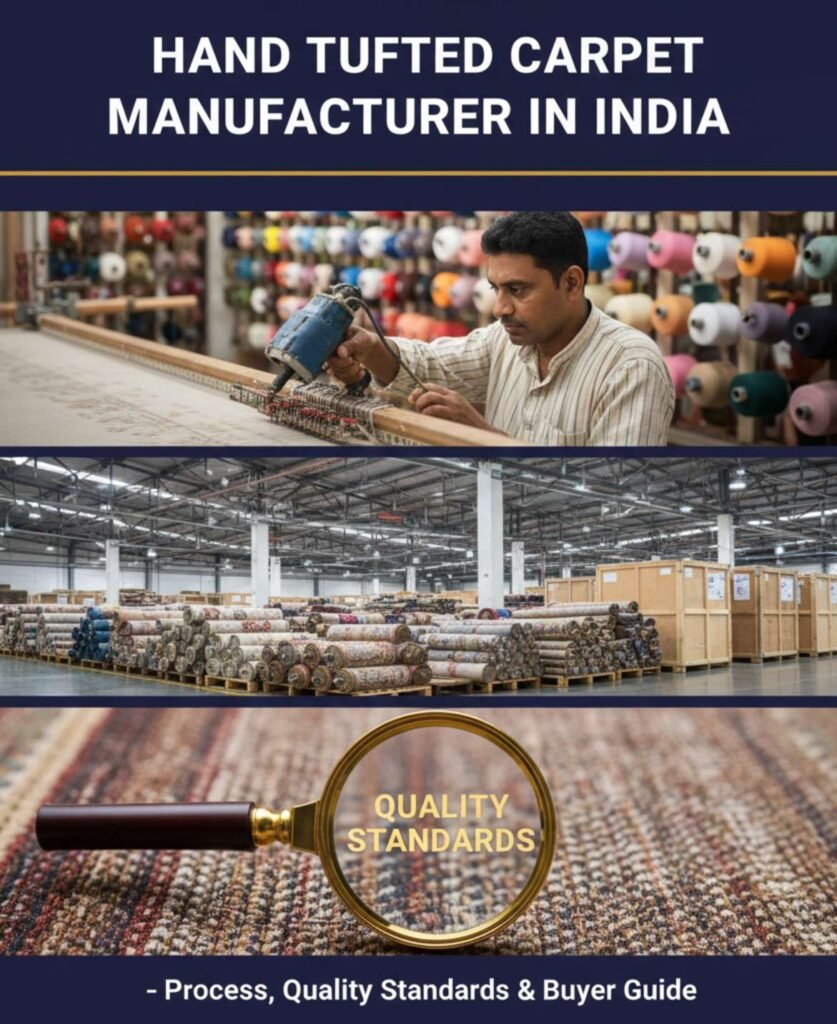
Hand tufted carpet manufacturer are a key segment of the handmade carpet industry, combining artisan craftsmanship with scalable production. For international buyers, understanding how hand tufted carpets are manufactured is essential for evaluating quality, durability, and long-term performance.
This guide explains the hand tufted carpet manufacturing process in India, including materials used, quality standards, certifications, and inspection criteria buyers should understand before selecting a manufacturer.
It is designed for importers, distributors, hospitality buyers, and interior design firms who want deeper insight into how hand tufted carpets are produced and how to assess manufacturing capability during sourcing.
Why Hand Tufted Carpets Manufacturer Dominate the Global handmade carpet market
Hand tufted carpets occupy a unique position between traditional hand-knotted rugs and fully machine-made carpets. This balance has made them the fastest-growing segment within handmade carpets globally.
International buyers increasingly choose hand tufted carpets because they offer:
- Faster production timelines compared to hand-knotted carpets
- Greater design flexibility than machine-made alternatives
- Custom sizes, colors, and patterns without industrial constraints
- Consistent quality suitable for hospitality, residential, and commercial projects
Markets including the USA, UK, European Union, Canada, and Japan continue driving demand, particularly in hospitality and mid-to-premium residential segments. For buyers seeking craftsmanship, scalability, and compliance, hand tufted carpets represent an optimal sourcing solution.
What Is a Hand Tufted Carpet? (Manufacturing Method Explained)
A hand tufted carpet is a handmade textile floor covering created using a specialized tufting gun rather than traditional hand-knotting. While the process remains manual and artisan-driven, it enables greater efficiency and design precision.
Hand Tufted Carpet Manufacturing Process – Step by Step
- Design Development & Artwork Preparation Production starts with technical design artwork. Patterns are mapped to scale, colors are finalized, and pile heights are defined to ensure accuracy during tufting.
- Frame Setup & Primary Backing Preparation A primary backing material—typically cotton, polyester, linen, or jute—is stretched tightly over a tufting frame to maintain dimensional stability.
- Tufting Using Manual or Electric Tufting Guns Skilled artisans use handheld tufting guns to punch yarn through the backing. Gun settings control pile height, spacing, and yarn density, enabling intricate patterns and textured effects.
- Pile Height & Density Control Throughout tufting, pile height and density are continuously monitored to ensure consistency across the carpet surface.
- Latex Application & Secondary Backing After tufting, latex adhesive is applied to secure the yarns in place. A secondary backing—canvas or fabric—is then bonded to provide strength and durability.
- Shearing, Trimming & Edge Binding The carpet surface is sheared for uniform pile height. Edges are trimmed and bound to prevent fraying and ensure a clean finish.
- Final Inspection & Finishing Each carpet undergoes quality inspection before packing, with focus on design accuracy, construction integrity, and finishing quality.
This process allows manufacturers to produce complex, customized designs efficiently while maintaining handmade character.
Hand Tufted vs Hand Knotted vs Machine-Made Carpets
Understanding the differences between carpet types helps buyers choose the right product for each application.
- Hand Knotted Carpets Offer exceptional durability and heritage craftsmanship, but require significantly longer production times and higher investment.
- Hand Tufted Carpets Deliver handmade quality with faster turnaround, design flexibility, and suitability for bulk and project-based orders.
- Machine-Made Carpets Provide high-volume consistency but limited customization and lower perceived craftsmanship value.
For hotels, commercial interiors, and design-driven residential projects, hand tufted carpets strike the best balance between aesthetics, performance, and scalability.
Materials Used in Hand Tufted Carpets & Their Performance
Material selection directly impacts durability, appearance, and end-use performance.
Common Fibers & Backing Materials
- Wool: Natural, resilient, and inherently flame-resistant; preferred for premium residential and hospitality applications
- Wool–Viscose Blends: Combine durability with enhanced sheen and visual depth
- Nylon / Polyamide: High durability and crush resistance; ideal for commercial environments
- Polypropylene: Moisture-resistant and cost-efficient for budget-conscious applications
- Cotton & Jute Backing: Provide structural stability and environmental appeal
Pile Height, Density & Durability Standards
Pile height typically ranges from low-profile designs to plush textures, depending on the intended application. Density—often measured using the APYD concept—determines how well the carpet resists crushing and wear.
Higher density carpets are preferred for hospitality and commercial spaces, while medium densities work well in residential settings.
Quality Standards Buyers Expect from production-Grade Hand Tufted Carpets
International buyers evaluate quality based on both physical performance and visual consistency.
Physical & Performance Quality Parameters
- Strong tuft bind to prevent yarn pull-out
- Secure backing adhesion without delamination
- Dimensional stability to prevent distortion
- Controlled shedding within acceptable limits
Design & Finishing Quality Checks
- Accurate pattern alignment and symmetry
- Uniform pile height across the surface
- Clean edge binding and finishing
- Acceptable handcrafted variations without functional defects
Reliable manufacturers maintain documented quality control systems to ensure consistency from sampling through bulk production.
Common Quality Defects in Hand Tufted Carpets (Buyer Inspection Guide)
Understanding potential defects helps buyers conduct effective inspections.
Manufacturing & Structural Defects
- Loose or uneven tufting
- Inadequate latex bonding leading to delamination
- Inconsistent pile height
- Visible backing due to low density
Visual & Dyeing Defects
- Color streaking from uneven dye absorption
- Pattern distortion caused by frame tension issues
- Crooked or sloping edges
- Shrinkage at carpet margins
Professional manufacturers implement multi-stage inspections to identify and correct these issues before shipment.
Certifications & Compliance Required for Global Carpet Imports
Compliance is critical in international carpet sourcing.
International Certifications Buyers Look For
- OEKO-TEX® STANDARD 100 for chemical safety
- ISO 9001:2015 for quality management systems
- ISO 14001 for environmental management
- GoodWeave Certification for ethical labor practices
- Additional standards such as GRS, GOTS, RWS, or SMETA when applicable
Market-Specific Compliance (USA, EU, UK)
- USA: CFR 1630/1631 flammability compliance and CPSC documentation
- European Union: REACH compliance, EN ISO flammability standards, labeling requirements
- United Kingdom: Post-Brexit tariff classification and textile labeling regulations
Manufacturer serving these markets must maintain current test reports and compliance documentation.
HS Codes & Documentation for Hand Tufted Carpets
HS Code Classification for Tufted Carpets
Hand tufted carpets typically fall under HS Code 5703, with sub-categories based on material composition. Accurate classification ensures correct duty assessment and smooth customs clearance.
Essential Export Documentation Checklist
- Commercial invoice and packing list
- Certificate of Origin
- Bill of Lading or Air Waybill
- Inspection certificates (if required)
- Insurance documentation
- Compliance and material certificates
Well-prepared documentation reduces delays and minimizes regulatory risk for importers.
How to Choose the Right Hand Tufted Carpet Manufacturer in India
India remains one of the world’s leading sources for handmade carpets. Selecting the right supplier requires careful evaluation.
Key Evaluation Criteria for buyers
- Proven production capacity and realistic lead times
- Documented quality control systems
- Valid certifications and audit transparency
- Clear communication and responsive account management
- Customization capability for designs, sizes, and materials
- Flexibility in minimum order quantities for trial orders
A structured evaluation process helps buyers mitigate sourcing risks.
Scalane International – Hand Tufted carpet manufacturer in India
Scalane International is an Indian manufacturer specializing in hand tufted carpets and handmade rugs. Our production focuses on consistent quality, material integrity, and compliance with international standards required by global buyers.
Experience & supply Capabilities
- Established operations serving international buyers
- Skilled artisan network combined with structured quality systems
- Capability to handle both custom designs and bulk project orders
- Strong focus on compliance, documentation, and ethical sourcing
Why Global Buyers Work with Scalane International
Buyers value Scalane International for consistent product quality, transparent manufacturing processes, and reliable supply execution. Clear communication, proper documentation, and a quality-first approach support long-term sourcing partnerships.
Learn more about manufacturing capabilities at www.scalaneinternational.com.
Ordering, Sampling & Customization Process
How Bulk & Custom Orders Are Handled
- Design consultation and technical artwork approval
- Pre-production samples or strike-offs for buyer validation
- Structured production timelines with defined checkpoints
- Final inspection prior to shipment
This process ensures alignment between buyer expectations and delivered products.
Frequently Asked Questions by International Buyers
Is shedding normal in hand tufted carpets? Initial shedding is normal, especially with wool carpets, and typically stabilizes with regular use and maintenance.
How long do hand tufted carpets last? With proper materials and density, hand tufted carpets can perform well for many years depending on traffic and usage patterns.
Can designs, colors, and sizes be customized? Yes. Hand tufting allows extensive customization for patterns, colors, sizes, and pile heights.
What certifications should importers insist on? OEKO-TEX, ISO 9001, and relevant flammability compliance are commonly expected for international markets.
How are quality issues handled post-shipment? Professional manufacturer maintain documented quality assurance and claims-handling processes.
Request Catalogue, Samples & buying Enquiry
Sourcing hand tufted carpets from India requires a partner that understands craftsmanship, compliance, and global trade expectations.
To explore collections, request samples, or discuss project requirements:
- Request a product catalogue
- Ask for material and quality samples
- Submit an purchase enquiry or specification request
Visit www.scalaneinternational.com or contact our team to begin your sourcing process with confidence.
While manufacturing quality is the foundation of a successful product, international buyers often require exporters who can manage documentation, compliance, and logistics.
Buyers looking for shipping, compliance, and international delivery support can review our hand tufted carpet exporter from India page.
This guide is written for international importers, distributors, and project buyers seeking reliable hand tufted carpet manufacturers from India, with a focus on quality, compliance, and long-term sourcing partnerships.