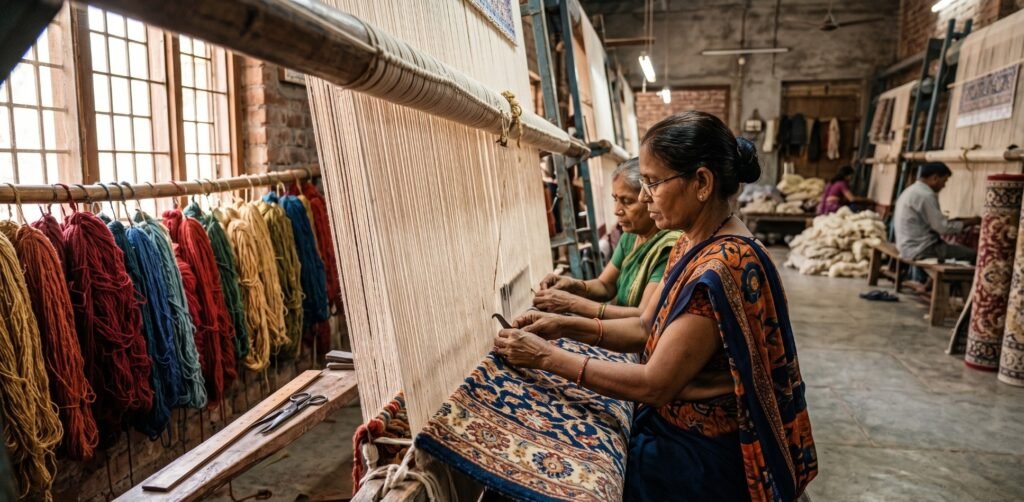
Importing hand knotted carpets from India can be highly profitable for wholesalers, retailers, interior designers, hospitality buyers, and online rug brands looking for premium handmade rugs with strong long-term value.
India is one of the world’s leading sources for handmade carpets, known for skilled artisan weaving, custom manufacturing capabilities, and competitive export pricing. Buyers worldwide import hand knotted carpets from India for luxury residential projects, hotels, retail collections, and commercial interiors.
If you are looking for a reliable hand knotted carpet exporter from India, explore our custom handmade rug manufacturing and export solutions designed for global wholesale buyers.
Why Importers Source Hand Knotted Carpets from India
India has built a strong global reputation for handmade carpet manufacturing. Skilled artisan communities, traditional weaving expertise, large-scale production capability, design flexibility, and strong export infrastructure make it one of the world’s most reliable sourcing destinations.
Indian hand knotted carpets are widely exported to the USA, UK, Germany, France, Russia, Spain, Netherlands, UAE, Saudi Arabia, Australia, Canada, and across Europe. Global buyers choose Indian handmade rugs because they offer premium craftsmanship, long lifespan, luxury appeal, strong retail margins, high customization capability, and reliable wholesale production.
What Is a Hand Knotted Carpet?
A hand knotted carpet is made by individually tying knots by hand onto a loom using wool, silk, or blended fibers. Unlike machine-made carpets, every knot is tied manually by skilled artisans — a highly labor-intensive process that gives hand knotted carpets their premium position in the global rug industry.
The result is greater durability, finer detailing, authentic handmade appeal, and long-term value that machine-made or hand tufted alternatives cannot match.
Hand Knotted vs Hand Tufted vs Machine-Made Carpets
Understanding construction differences is important for importers and wholesale buyers positioning products across market tiers.
Hand Knotted Carpets Individually tied knots, no adhesive backing, long lifespan, premium quality positioning, and higher durability. Best for luxury retail, hospitality, interior design projects, and high-end residential use.
Hand Tufted Carpets Made using tufting guns with latex backing. Faster production, lower cost, and shorter lifespan. Suitable for mid-market retail, commercial interiors, and faster project timelines.
Machine-Made Carpets Produced on automated looms with uniform appearance and lower production cost. Limited artisanal value. Suitable for mass-market applications and budget-focused collections.
Understanding KPSI in Hand Knotted Carpets
KPSI (knots per square inch) is one of the most important quality indicators in hand knotted carpets. Higher KPSI generally means more intricate detailing, finer weaving, greater durability, and longer production time. Importers should select KPSI based on budget, end use, design complexity, and customer expectations.
Commercial Grade — Lower-density weaving suited for commercial spaces, hospitality projects, and functional use.
Premium Grade — Balanced quality and detail suited for retail collections, residential interiors, and interior design projects.
Luxury Grade — High-density hand knotted carpets designed for luxury homes, signature hospitality projects, and premium designer collections.
Materials Used in Hand Knotted Carpets
Material selection directly affects carpet durability, appearance, and market positioning.
Wool Hand Knotted Carpets Wool is the most commonly used material because it offers natural durability, soft texture, color retention, resilience, and easy maintenance. Suitable for residential interiors, hospitality projects, and high-traffic areas.
Silk and Wool-Silk Blend Carpets Silk and wool-silk blends are used for fine detailing, luxury appearance, and designer collections. Commonly found in luxury residences, boutique hotels, and high-end retail collections.
Natural vs Synthetic Dyes Natural dyes offer an organic appearance and traditional craftsmanship appeal, making them popular for sustainable collections. Synthetic dyes provide better shade consistency and strong colorfastness, making them better suited for large-scale production. Professional manufacturers test dyes for colorfastness, safety compliance, and export standards.
Certifications Buyers Should Look For
Certifications help importers verify quality, ethical practices, and compliance standards. Important certifications include GoodWeave, OEKO-TEX®, Woolmark, GOTS, and ISO quality systems.
These certifications are particularly important for European markets, hospitality projects, ethical sourcing requirements, and premium retail programs.
How to Evaluate a Hand Knotted Carpet Supplier
Choosing the right supplier is one of the most important decisions for importers.
Can the supplier handle custom designs? Customization capability is critical for retail and hospitality buyers who need specific sizes, colors, patterns, and construction quality.
Are technical specifications clearly documented? Reliable exporters provide material details, KPSI specifications, carpet weight, and full construction details.
Is export experience proven? Suppliers should demonstrate clear knowledge of international shipping, documentation, packaging, and customs requirements.
Are quality inspections standardized? Consistent quality control reduces risk in bulk orders and ensures production consistency across shipments.
Red flags to avoid: Suppliers that offer unrealistically low pricing, cannot explain construction quality, lack export documentation knowledge, refuse sampling support, or cannot maintain production consistency.
Export Documentation for Hand Knotted Carpet Imports
Professional exporters provide complete export documentation including commercial invoices, packing lists, certificate of origin, shipping documents, and HS code classification support. Hand knotted carpets are generally classified under HS Code 5701. Proper documentation helps avoid customs delays and import complications.
Shipping and Packaging for International Carpet Orders
Hand knotted carpets are commonly shipped through full container loads (FCL), less-than-container loads (LCL), or air freight for urgent shipments. Professional export packaging includes moisture-resistant wrapping, protective covering, and export-safe packing methods to reduce damage during international transit.
Common Mistakes Buyers Make When Importing Handmade Rugs
Many first-time importers focus only on pricing while overlooking quality and supplier reliability. Working with experienced exporters reduces these risks significantly.
Common mistakes include ignoring KPSI differences between construction grades, choosing suppliers based on price alone, skipping product sampling before placing bulk orders, overlooking certifications required for target markets, failing to confirm production timelines upfront, and not verifying the exporter’s international shipping experience.
Why Wholesale Buyers Work with Indian Carpet Exporters
India remains one of the strongest sourcing destinations for handmade rugs because it offers skilled weaving expertise, large-scale production, better customization capability, competitive manufacturing costs, and strong export infrastructure. Indian exporters support wholesale rug collections, hospitality projects, OEM manufacturing, private label programs, and interior design sourcing.
Choosing the Right Hand Knotted Carpet for Your Market
The right carpet construction depends on customer segment, usage environment, budget range, design preference, and maintenance expectations. Wholesale buyers often balance commercial durability, visual appeal, pricing strategy, and market positioning. Understanding these factors helps importers build more successful carpet collections.
FAQs
What is the difference between hand knotted and hand tufted carpets? Hand knotted carpets are individually tied by hand and offer superior durability and long-term value. Hand tufted carpets use tufting guns and latex backing for faster production at lower cost, but with a shorter lifespan.
What is KPSI in hand knotted carpets? KPSI stands for knots per square inch and is used to measure carpet density, detailing quality, and weaving complexity. Higher KPSI generally indicates a finer, more durable hand knotted carpet.
Why do importers source hand knotted carpets from India? India is known for skilled artisan weaving, premium craftsmanship, high customization capability, competitive export pricing, and strong export infrastructure.
Which certifications are important for handmade carpet imports? GoodWeave, OEKO-TEX®, Woolmark, GOTS, and ISO certifications are commonly important, particularly for European markets, hospitality projects, and ethical sourcing programs.
How are hand knotted carpets shipped internationally? Most bulk shipments move through sea freight using export-safe packaging and full international shipping documentation. Air freight is available for urgent shipments.
Can handmade rugs be customized for wholesale buyers? Yes. Professional manufacturers can customize sizes, colors, patterns, materials, and construction quality for wholesale, hospitality, and OEM programs.
Import Hand Knotted Carpets from India with Scalane International
Scalane International supports wholesale buyers, importers, hospitality companies, and interior sourcing firms with export-ready handmade carpet solutions from India. Our team helps buyers with product development, sampling, custom rug manufacturing, bulk production, export documentation, and shipping coordination.
Explore our hand knotted carpet exporter page to learn more about our manufacturing and wholesale export capabilities.
Looking to import hand knotted carpets from India for your retail, hospitality, or wholesale business?
Contact our team for product catalogues, sampling support, bulk pricing, OEM manufacturing, and export assistance.
WhatsApp: +91 9408897009
Email: exports@scalaneinternational.com