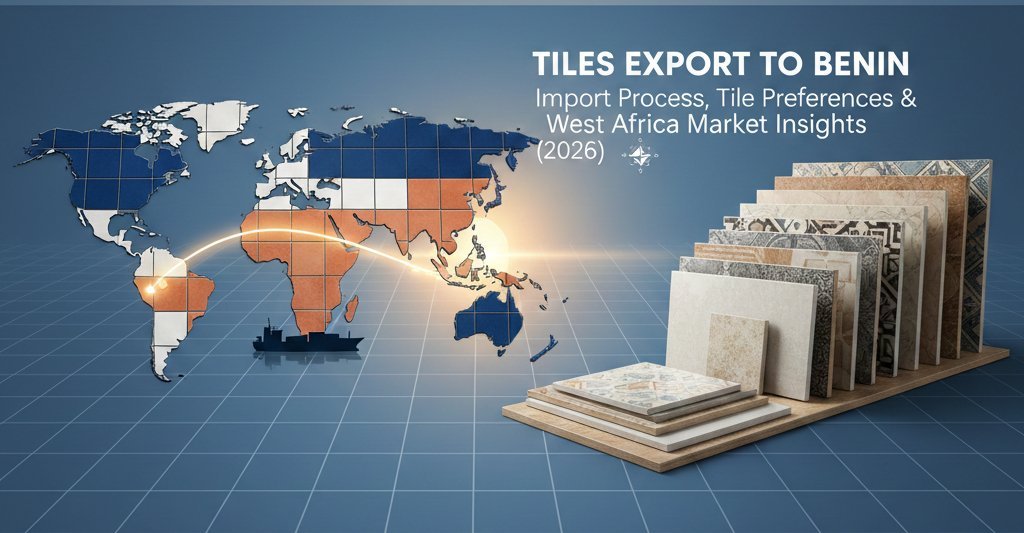
Benin has become one of the most strategic entry points for the West African ceramic tile market. With a modernized port in Cotonou, active ECOWAS membership, and expanding construction activity, the country serves as both a domestic consumption market and a regional redistribution hub for Nigeria, Niger, Burkina Faso, and neighboring economies.
For tile importers, distributors, wholesalers, and project buyers, Benin presents significant opportunity—alongside notable complexity. Your success hinges on understanding import regulations, compliance requirements, buyer expectations, and identifying reliable exporters who deliver consistent quality at scale.
This 2026 guide offers a complete, practical overview of tiles export to Benin, covering the import process, tile preferences, logistics considerations, quality standards, and West Africa market insights—written specifically for B2B decision-makers.
Tiles export to Benin : Why Benin Is a Strategic Entry Point for West Africa Tile Exports
Benin’s Role in the ECOWAS & AfCFTA Trade Framework
Benin operates under the ECOWAS Common External Tariff (CET), which harmonizes import duties across West African member states. This framework simplifies cross-border trade and enables goods imported into Benin to move across the region with fewer barriers.
The African Continental Free Trade Area (AfCFTA) further strengthens Benin’s position as a trade gateway by encouraging regional sourcing and improving long-term tariff efficiency. Many importers strategically use Benin as a landing point before distributing to Nigeria, Niger, Burkina Faso, and Togo—making it particularly attractive for bulk tile imports.
Construction & Infrastructure Demand Drivers (2026)
Several key factors are driving sustained tile demand across Benin and West Africa:
- Rapid urban housing development in coastal and inland cities
- Expansion of commercial, retail, and mixed-use developments
- Government-backed housing and infrastructure programs
- Growing middle-class demand for modern interior finishes
- Increased exposure to global design trends through digital platforms
These market dynamics position Benin as an import-dependent market with consistent demand for ceramic, porcelain, vitrified, GVT, and PGVT tiles.
Tiles export to Benin: Ceramic Tile Import Process in Benin – Step-by-Step
Understanding the import process is essential to avoid delays, penalties, and unexpected compliance issues.
HS Codes for Ceramic & Porcelain Tiles
Ceramic tiles fall under Chapter 69 of the Harmonized System. The most commonly used codes include:
- HS 6907 – Glazed ceramic wall, floor, and paving tiles
- HS 6908 – Unglazed ceramic tiles
Sub-categories further distinguish between wall tiles, floor tiles, mosaic tiles, and specialty applications. Accurate HS code classification is critical—it directly impacts customs duties and clearance timelines.
Import Duties, VAT & ECOWAS Tariffs
Benin applies the ECOWAS CET, with duty rates varying by product type and country of origin. Additionally, an 18% Value Added Tax (VAT) applies at the point of import. VAT can be refunded through proper fiscal declaration, making accurate documentation essential from both a compliance and cost perspective.
Tiles manufactured within ECOWAS member states may qualify for preferential duty treatment, while imports from Asia and Europe fall under standard CET assessment.
Mandatory Import Documentation Checklist
To ensure smooth customs clearance, importers must prepare these documents:
- Commercial invoice with detailed product descriptions
- Original Bill of Lading showing weight, quantity, and destination
- Packing list with box-level specifications
- Certificate of Origin from the manufacturing country
- Pre-shipment inspection certificate from an accredited agency
- Cargo Tracking Note (BSC)
- Customs declaration through GUCE / SYDONIA
Missing or inconsistent documentation remains one of the most common causes of clearance delays in Benin.
Customs Clearance, Labeling & Compliance Requirements
Customs Clearance Timeline & Inspection Process
Benin operates a single-window customs system (GUCE), supported by the SYDONIA WORLD declaration platform. With complete and accurate documentation, clearance typically proceeds efficiently. Physical inspections are standard practice, particularly for construction materials.
Most delays stem from HS code discrepancies, missing origin documentation, or unclear product descriptions.
Labeling & Marking Rules (Critical for Approval)
Labeling compliance is non-negotiable in Benin. All tiles and packaging must clearly display:
- Country of origin (in French or English)
- “Imported” or “Importé” marking
- Shipper name and destination details
Incorrect or misleading labeling can result in cargo seizure or financial penalties.
Standards, Testing & Certifications Accepted in Benin
While Benin doesn’t mandate tile-specific certifications, buyers and customs authorities have strong preferences for:
- ISO 13006 for ceramic tile performance standards
- ISO 9001 for quality management systems
- Third-party laboratory test reports (Bureau Veritas, SGS, or equivalent)
These documents substantially improve buyer confidence and reduce clearance friction.
Shipping & Logistics for Exporting Tiles to Benin
Port of Cotonou – Main Entry Point
The Autonomous Port of Cotonou serves as Benin’s primary maritime gateway and a major hub for West Africa. The port handles both full-container-load (FCL) and less-than-container-load (LCL) shipments and provides road connectivity for efficient inland distribution.
Transit Times by Origin
Shipping timelines vary depending on origin country, but experienced exporters carefully plan production, inspection, and dispatch schedules to align with project deadlines and seasonal demand peaks.
Logistics Risks & How Professional Exporters Mitigate Them
Common risks include tile breakage, port congestion, and demurrage charges. Professional exporters mitigate these through:
- Reinforced packaging and proper palletization
- Moisture-resistant packing materials
- Advance documentation preparation
- Coordination with reliable, experienced freight forwarders
Tile Size, Finish & Design Preferences in Benin & West Africa
Most In-Demand Tile Sizes
The 600x600mm tile continues to dominate as the most popular format, valued for its versatility, cost efficiency, and ease of installation. Demand for larger formats is steadily growing, particularly in premium residential and commercial projects.
Preferred Finishes & Surface Types
- Glazed ceramic tiles dominate residential applications
- Vitrified and porcelain tiles are increasingly chosen for durability
- Digitally printed marble-effect and wood-effect tiles are gaining strong traction
- Matte and anti-slip finishes are preferred for contemporary spaces and wet areas
Application-Based Demand
Tiles find widespread use across:
- Residential floors and walls
- Retail stores and office spaces
- Hotels and hospitality projects
- Outdoor installations and high-traffic environments
Quality Expectations of Tile Importers in Benin
Non-Negotiable Quality Parameters
Importers demand strict consistency across:
- Dimensions and thickness
- Color and shade uniformity
- Surface finish free from defects
- Water absorption rates and mechanical strength
Performance Requirements for Tropical Climates
Given West Africa’s climate, tiles must withstand high humidity, temperature fluctuations, and frequent cleaning without visible degradation.
Sampling, Inspection & Batch Consistency
Most buyers require physical samples and pre-shipment inspections before committing to larger orders. Batch traceability and robust quality control systems serve as key differentiators when selecting a long-term supplier.
Competitive Landscape – Where Exporters Can Win in West Africa
China dominates volume-driven market segments, while Spain and Italy cater to premium niches. India and Turkey increasingly capture the value-quality segment—offering a compelling balance of affordability, contemporary design, and compliance readiness.
Exporters who combine consistent quality, documentation expertise, and responsive communication position themselves for long-term success in this market.
Buyer Psychology – What Tile Importers Look for Before Enquiry
Key Concerns Importers Want Resolved
- Will quality remain consistent across multiple shipments?
- Can delivery timelines be reliably met?
- Will documentation pass customs inspection without issues?
- Is the supplier financially and operationally stable for long-term partnership?
Trust Signals That Drive Supplier Selection
- ISO certifications and third-party inspection reports
- Transparent specifications and proactive communication
- Demonstrated export experience to African markets
Information Buyers Expect Before Contacting a Supplier
- Complete product specifications and technical data
- Compliance documentation and test certificates
- Clear lead times and logistics capabilities
Why Importers Choose Scalane International as Their Tile Export Partner
Scalane International is an Indian exporter of ceramic, porcelain, vitrified, GVT, and PGVT tiles, serving distributors, wholesalers, and project buyers across global markets, including Africa.
Proven Experience in Tile Exports to Africa
Scalane International has working knowledge of Benin’s import procedures, ECOWAS requirements, and the practical realities of shipping tiles to West African markets.
Quality, Compliance & Export Readiness
The company collaborates with ISO-aligned manufacturing partners, facilitates third-party inspections, and maintains documentation accuracy to support smooth customs clearance.
Reliable Supply for Distributors & Projects
Through consistent batch quality, scalable production capacity, and a partnership-driven approach, Scalane International supports both bulk distribution and project-specific requirements.
Common Tile Import Mistakes in Benin (and How to Avoid Them)
- Incorrect HS code classification
- Incomplete or inaccurate labeling
- Inadequate packaging leading to breakage
- Skipping pre-shipment inspection
- Partnering with exporters lacking Africa-specific experience
Avoiding these common pitfalls significantly reduces operational risk and total landed cost.
FAQs – Tile Import & Export to Benin
How do I import ceramic tiles into Benin? Follow ECOWAS CET regulations, prepare accurate documentation, and process customs clearance through the GUCE system.
What certifications are required for tile exports? While not legally mandatory, ISO 13006 and ISO 9001 are strongly preferred, along with third-party test reports from recognized agencies.
What tile sizes sell best in Benin? 600x600mm remains the best-selling format, though demand for larger formats is growing in premium segments.
Ceramic vs porcelain tiles – which is better for West Africa? Both have applications, but porcelain and vitrified tiles are increasingly preferred for superior durability and moisture resistance.
How can I verify a tile exporter’s reliability? Review their certifications, request inspection reports, examine export history to Africa, and assess communication responsiveness during initial contact.
Ready to Import Tiles to Benin?
If you’re sourcing tiles for Benin or the broader West African market, partnering with an experienced exporter streamlines compliance, logistics, and quality assurance.
Next steps:
- Request a tile catalogue
- Request samples for quality evaluation
- Get import consultation for Benin & West Africa
- Submit a bulk enquiry or RFQ
Explore Scalane International’s export capabilities at www.scalaneinternational.com and connect with a team that understands global tile trade, compliance frameworks, and long-term B2B partnerships.