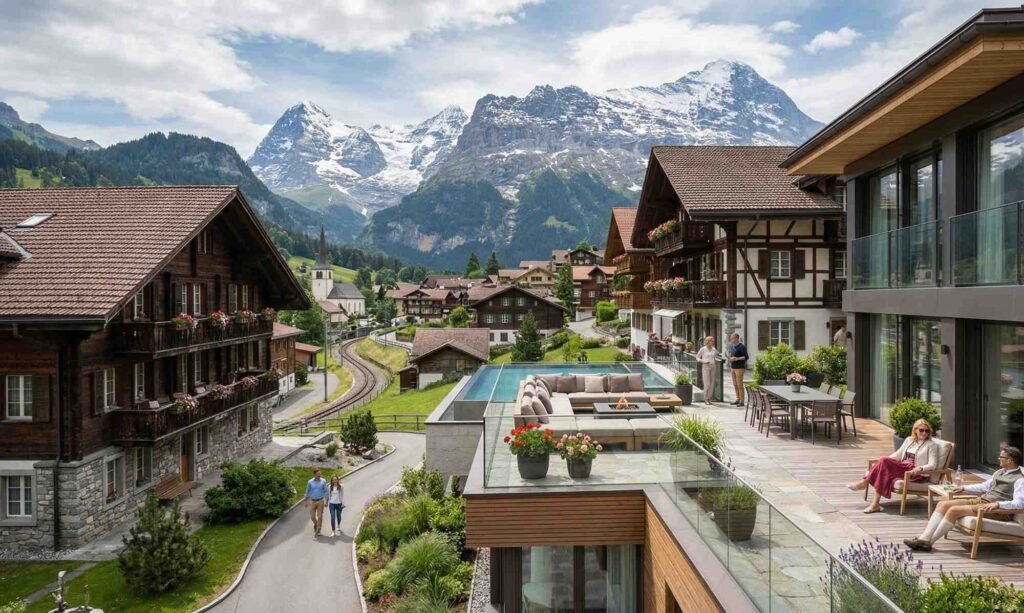
1. Definition Block
Tiles exporter to Switzerland, Scalane International supplies porcelain, ceramic, and vitrified tiles from India with full EU and Swiss compliance. Tiles export to Switzerland from India covers the supply of CE-marked ceramic, porcelain, and vitrified tiles that fully comply with EN 14411, ISO 10545, and Swiss SIA 248 standards.
These tiles are:
-
- Frost-resistant and built for Switzerland’s cold climate and alpine conditions
-
- Designed for both indoor and outdoor applications, including terraces and balconies
-
- Delivered via EU ports with complete documentation — DoP, TDS, and EPD
-
- Used across residential renovation, commercial developments, and infrastructure projects
2. Switzerland Tile Market Overview
The Switzerland tile market is shaped by a strong preference for precision, durability, and understated design.
Market dynamics:
-
- Renovation drives over 60% of demand, largely due to an aging building stock
-
- Strong preference for porcelain tiles with water absorption of ≤0.5%
-
- High demand for tiles compatible with underfloor heating systems
-
- Growing adoption of large-format and rectified tiles
Design trends in Switzerland:
-
- Minimalist aesthetics rooted in Swiss precision and craftsmanship
-
- Matte and soft-touch surface finishes
-
- Natural looks: marble, stone, wood, and concrete effects
-
- Neutral palettes: grey, beige, and earthy tones
Application segmentation:
| Segment | Key Demand |
|---|---|
| Residential | Renovation, bathrooms, kitchens |
| Commercial | Offices, hotels, healthcare |
| Outdoor | Frost-resistant terrace & balcony tiles |
3. Types of Tiles Exported to Switzerland
Ceramic Tiles
Ceramic tiles are well-suited for wall applications and light-duty residential use. They are a practical choice for kitchens and bathrooms, commonly supplied in matte and satin finishes. Their cost efficiency makes them a popular option for renovation-driven demand across Switzerland.
Porcelain Tiles
Porcelain tiles are the most in-demand category in the Swiss market. Their low porosity and frost resistance make them suitable for both indoor and outdoor environments, and they perform exceptionally well with underfloor heating systems.
Popular sizes supplied to Switzerland include:
-
- 60×60 cm
-
- 60×120 cm
-
- 120×120 cm
Vitrified Tiles
Vitrified tiles are used extensively in premium residential and commercial projects. They offer high durability and strong mechanical performance, and their rectified edges allow for tight grout joints of just 1–2 mm — a finishing standard expected by Swiss buyers. They are equally suited to high-traffic areas where long-term surface integrity matters.
GVT / PGVT Tiles
Glazed and polished glazed vitrified tiles combine digital print technology with premium aesthetics, replicating marble, wood, and concrete surfaces to a standard that competes with Italian design benchmarks. These tiles align well with contemporary Swiss architectural preferences for refined, natural-looking interiors. As a leading tiles exporter to Switzerland, we focus on quality, consistency, and compliance.
4. Why Switzerland Imports Tiles from India
Switzerland imports tiles from India to secure a reliable combination of design quality, technical compliance, and supply consistency.
Key advantages:
-
- A competitive alternative to Italian and Spanish suppliers
-
- A broad range of minimalist and natural surface designs
-
- OEM customization options for Swiss distributors and project developers
-
- Large-scale production capacity that ensures batch consistency
-
- Growing alignment with EU and Swiss technical standards
Market positioning:
Indian tiles increasingly occupy the space between Italian-quality aesthetics and optimized supply value — making them a practical and design-conscious choice for both retail and project segments in Switzerland.
5. Compliance & Standards (Switzerland Focus)
Exporting tiles to Switzerland requires strict adherence to both EU directives and Swiss-specific standards. Buyers and importers expect full documentation before approving any shipment.
Mandatory compliance:
-
- EN 14411 — tile classification standard
-
- EN ISO 10545 — testing methodology
Swiss-specific requirements:
-
- Bfu slip resistance ratings (R9 to R12)
Required documentation:
-
- Declaration of Performance (DoP)
-
- Technical Data Sheet (TDS)
-
- Water absorption ≤0.5% (porcelain)
-
- Breaking strength values (N ratings)
Sustainability expectations:
-
- Environmental Product Declaration (EPD)
-
- Low VOC emissions (A+ rating)
-
- Compatibility with green building certification schemes
6. Logistics & Shipping to Switzerland
Tile exports to Switzerland involve a multi-stage transit route through major European ports before reaching the final destination.
Shipping route:
India (Mundra / Nhava Sheva) → Rotterdam / Antwerp / Hamburg → Basel
Transport flow:
-
- Sea freight (FCL) to an EU port
-
- EU customs clearance
-
- Inland transport by rail, barge, or truck
-
- Final delivery in Switzerland
Key logistics considerations:
-
- 20-foot containers are preferred due to weight distribution requirements
-
- Swiss road weight limits cap at 40 tonnes
-
- Winter shipments require specific moisture protection measures
-
- The Rhine barge route offers an eco-efficient option for inland delivery to Basel
7. Packaging & Quality Assurance
Swiss buyers expect zero damage on arrival and complete consistency across every box in a consignment. Packaging and quality control are not optional — they are baseline requirements.
Packaging standards:
-
- Euro pallets (800×1200 mm) are mandatory for Swiss and EU delivery
-
- Reinforced cartons with full edge protection
-
- Shrink wrapping and secure pallet strapping
-
- Desiccants included for moisture control during long-haul transit
Breakage prevention:
-
- Multi-layer packaging systems for fragile tile formats
-
- Balanced and properly distributed container loading
-
- Anti-moisture protection suited to alpine transit conditions
Quality assurance:
-
- Shade (tone) consistency verified across production batches
-
- Caliber (size) precision checked to rectified standards
-
- Surface and finish inspection prior to packing
-
- Pre-dispatch inspection reports provided on request
8. Buyer Decision Factors (Switzerland)
Swiss buyers prioritize reliability, technical precision, and compliance over cost alone. Understanding what drives their decisions is essential for any supplier looking to enter or grow in this market.
Key decision drivers:
-
- Zero tolerance for shade variation or size inconsistency between batches
-
- Strong preference for rectified tile edges
-
- Consistent, on-time delivery performance
-
- Complete and accurate technical documentation at every stage
Sample approval process:
-
- Initial loose-piece samples submitted for design and surface assessment
-
- Batch-specific approval samples required before production confirmation
Top product requirements:
-
- Proven frost resistance
-
- Anti-slip ratings of R11 or R12 for outdoor and wet areas
-
- Consistent minimalist design across the full batch
9. Competitive Comparison — India vs Italy vs Spain vs Turkey
| Country | Strength | Weakness |
|---|---|---|
| Italy | Premium design authority | High cost |
| Spain | Design flexibility | Higher pricing |
| Turkey | Fast delivery | Limited design depth |
| India | Value, scale, and variety | Perception gap vs. established origins |
India’s strategy in Switzerland:
Indian exporters are closing the perception gap by combining design quality with technical compliance and strong batch consistency. Offering customization for distributors and maintaining supply reliability are the pillars of India’s growing presence in the Swiss tile market.
10. About Scalane International
Scalane International is a tile exporter from India with a focused presence in Switzerland and broader European markets.
The company works with export-oriented production partners to supply porcelain, vitrified, and GVT/PGVT tiles in bulk and customized formats. Its operations are built around EU and Swiss compliance requirements, with logistics experience spanning multiple European destinations.
11. Why Choose Scalane International
-
- CE-compliant tiles selected specifically for the Swiss market
-
- Product range aligned with Swiss design and technical standards
-
- Strict batch consistency control across every shipment
-
- OEM and private label capabilities for distributors
-
- Fast, professional documentation handling
-
- Proven EU logistics and customs coordination
12. Trust
Packaging All shipments are packed to Euro pallet standards using export-grade reinforced materials — built to arrive intact, regardless of transit conditions.
Quality Control Every consignment undergoes pre-dispatch inspection. Third-party testing through accredited agencies such as SGS and TÜV is available on request.
Logistics Shipments are routed through optimized EU corridors to ensure timely and cost-efficient delivery to Switzerland.
Reliability Scalane International maintains consistent repeat supply capability and operates with full transparency throughout the order and shipment process.
Experience Scalane International has extensive, hands-on experience exporting tiles to Switzerland, with a clear understanding of Swiss compliance requirements and the expectations of Swiss importers and distributors.
Certifications
-
- CE marking on exported tile products
-
- ISO-certified production partnerships
-
- Environmental Product Declarations (EPD) available upon request
Export Markets
-
- Switzerland
-
- Germany
-
- Belgium
14. Answer Blocks
Q: What are the requirements to export tiles to Switzerland?
A: CE marking, compliance with EN 14411, a Declaration of Performance (DoP), and alignment with SIA 248 standards are all required.
Q: Are Indian tiles suitable for Switzerland’s climate?
A: Yes. Frost-resistant porcelain tiles with water absorption of ≤0.5% are well-suited to Swiss conditions, including alpine environments.
Q: Which tiles are best for Swiss outdoor use?
A: 20 mm anti-slip porcelain tiles with R11 or R12 slip resistance ratings are the recommended choice for terraces, balconies, and other outdoor surfaces.
Q: How are tiles shipped to Switzerland from India?
A: Tiles travel by sea freight to EU ports such as Rotterdam or Antwerp, followed by inland transport — by rail, barge, or truck — to the final destination in Switzerland.
15. FAQ Section
General Import & Regulations
What certifications are required to import tiles into Switzerland? Tiles must carry CE marking, comply with the relevant EN standards, and be supported by a Declaration of Performance and full technical documentation.
Do tiles need to comply with Swiss standards? Yes. Alignment with SIA 248 and Swiss slip resistance standards is important for project acceptance and regulatory approval.
Are Indian tiles accepted in Switzerland? Yes, provided they meet EU and Swiss compliance requirements and demonstrate consistent quality.
Logistics & Shipping
How are tiles transported to Switzerland? Tiles are shipped by sea to an EU port and then transported inland to Switzerland by rail, road, or barge, depending on the route and volume.
What packaging is required for tile export? Euro pallets, reinforced cartons with edge protection, and moisture control measures are all mandatory for export to Switzerland.
How is breakage prevented during shipping? Through robust multi-layer packaging, proper palletization, balanced container loading, and moisture protection throughout transit.
Supplier Selection
What should I look for in a tile supplier? CE compliance, consistent batch quality, proven EU export experience, and reliable logistics coordination are the essential criteria.
Can tiles be customized for Swiss buyers? Yes. OEM customization — including tile design, size, and packaging — is available for distributors and project buyers.
Product & Installation
Which tiles are best for Swiss climate?
Porcelain tiles with low water absorption and certified frost resistance are the most suitable for Switzerland’s climate.
What tile sizes are popular in Switzerland?
Large formats dominate: 60×60 cm, 60×120 cm, and 120×120 cm are the most commonly specified sizes.
What slip resistance rating is required?
Ratings from R9 to R12 are required depending on the application. R11 and R12 are standard for outdoor and wet-area surfaces.
Why is batch consistency so important?
Swiss buyers operate to tight tolerances. Uniform color tone and calibrated size across the full batch are non-negotiable for both residential and commercial projects.
Are tiles compatible with underfloor heating?
Yes. Porcelain tiles conduct and distribute heat efficiently, making them highly compatible with underfloor heating systems.
16. CTA
-
- Request a quotation for tiles export to Switzerland
-
- Get the CE-compliant tile catalog for Swiss projects
-
- Order samples for evaluation and batch approval
Contact a trusted tiles exporter to Switzerland for bulk supply and project requirements.
Import Process for Switzerland
- Order samples for evaluation and batch approval