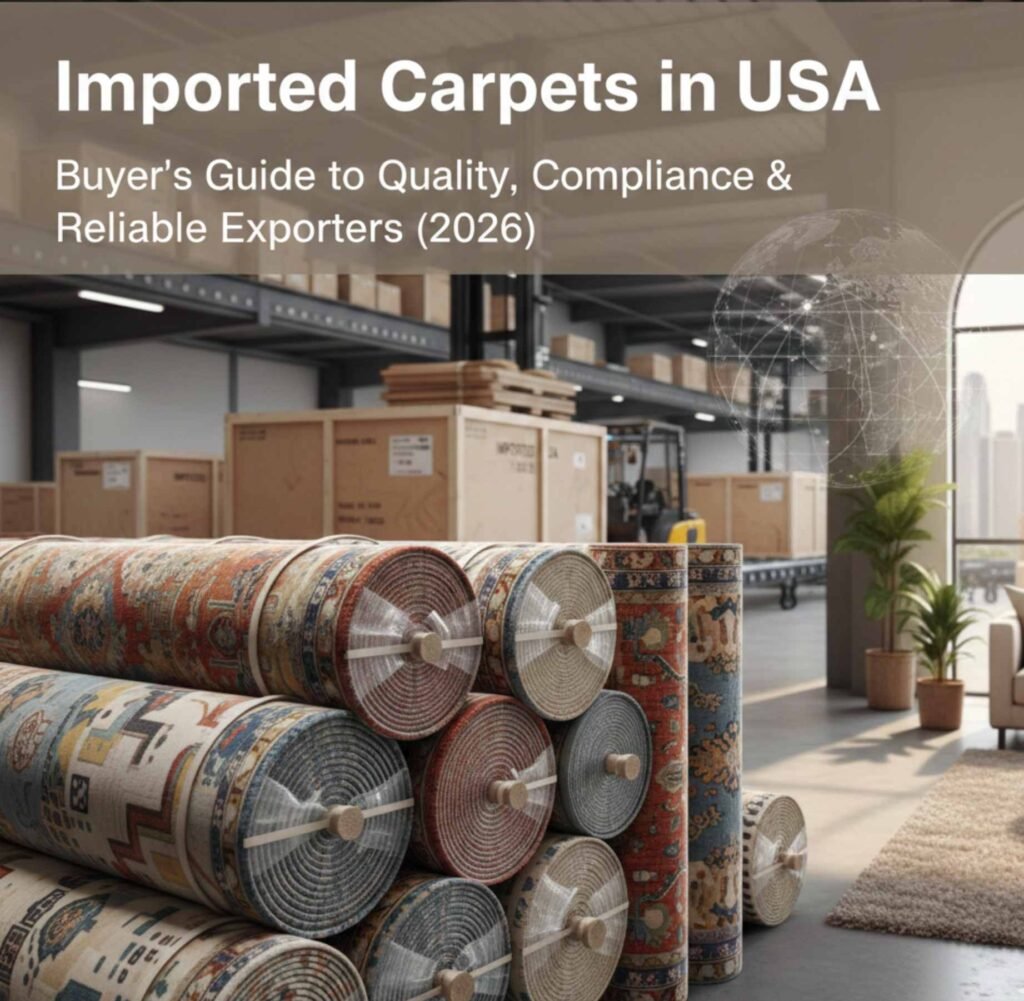
Imported carpets in USA play a critical role in meeting the demand for residential, commercial, hospitality, and large-scale project flooring across the country. From residential remodeling and multi-family housing to hospitality venues, corporate offices, and institutional projects, demand for high-quality carpets continues strong. As sourcing becomes increasingly global, US importers rely more heavily on overseas manufacturers and exporters to meet their design, volume, and performance requirements.
This guide is written specifically for US importers, distributors, wholesalers, retailers, and project buyers. It explains how carpet imports into the USA work, what compliance and quality standards must be met, and how to evaluate reliable exporters for long-term sourcing partnerships in 2026 and beyond. For US buyers, sourcing imported carpets in USA requires careful attention to compliance, labeling, quality standards, and exporter reliability.
Overview of the Imported Carpet Market in the USA
Imported carpets play a critical role across multiple segments of the US flooring market. While domestic production remains important, overseas suppliers contribute significantly to product diversity, design innovation, and supply flexibility.
Imported carpets are widely used in:
- Residential homes, apartments, and renovations
- Commercial offices, educational facilities, and public buildings
- Hospitality environments including hotels, resorts, and entertainment venues
- Large-scale projects such as multi-family housing and senior living communities
Over the past 12–24 months, importer priorities have shifted noticeably. Buyers now place greater emphasis on compliance reliability, documentation accuracy, sustainable materials, and traceable supply chains. Overseas sourcing is no longer driven solely by product availability—it’s increasingly about the exporter’s ability to meet US regulatory expectations consistently and support long-term programs without disruption.
Understanding HS Codes & Trade Classification for Carpet Imports
HS Chapter 57 – Carpets and Textile Floor Coverings
All carpets and textile floor coverings imported into the USA are classified under HS Chapter 57. This chapter covers a wide range of products, including hand-knotted rugs, woven carpets, tufted broadloom, carpet tiles, nonwoven floor coverings, and specialty mats.
Common HS headings used for carpet imports include:
- Knotted carpets and rugs
- Woven, non-tufted floor coverings
- Tufted carpets and tiles
- Felt and nonwoven carpets
- Other textile floor coverings not elsewhere classified
- Jute carpets
- Kilim carpets
Within each heading, US HTS subheadings further distinguish products based on construction method, pile structure, fiber type, and whether the product is finished rugs or roll goods.
How HS Classification Impacts US Imports
Correct HS classification is foundational to a smooth import process. It influences customs treatment, compliance alignment, and documentation accuracy. Misclassification can result in delays, re-examination at the port, or post-entry audits.
US importers expect exporters to:
- Clearly describe product construction and materials
- Provide consistent fiber and construction disclosures
- Maintain auditable classification notes for each product line
Accurate classification ensures that labeling, testing, and regulatory documentation align with the actual product being shipped.
Why imported carpets in USA require strict compliance
The import treatment of carpets into the USA depends on several key factors, including:
- Country of origin
- Construction method and fiber composition
- Applicability of trade remedies or preference programs
Changes in trade policy, origin rules, or regulatory interpretations can affect shipments if exporters aren’t prepared to adapt quickly.
What US Importers Expect from Exporters
Experienced US buyers look for exporters who provide:
- Transparent disclosure of materials and production locations
- Clean, complete, and consistent documentation
- Proactive communication on regulatory or policy changes
Exporters who understand trade sensitivity and compliance expectations are viewed as lower-risk sourcing partners.
Regulatory Requirements for Importing Carpets into the USA
Key US Authorities Governing Carpet Imports
Several US agencies regulate carpet and rug imports:
- US Customs and Border Protection (CBP) oversees customs clearance, classification, valuation, and country-of-origin marking
- Consumer Product Safety Commission (CPSC) enforces flammability standards under the Flammable Fabrics Act
- Federal Trade Commission (FTC) regulates fiber identification, wool labeling, and care labeling
Certain buyers may also require declarations related to environmental or chemical compliance frameworks.
Consequences of Non-Compliance
Failure to meet US regulatory requirements can lead to:
- Detention or seizure of goods at the port
- Product recalls and civil penalties
- Loss of buyer confidence and cancelled contracts
For importers, compliance reliability is often the most critical sourcing consideration.
Labeling, Flammability & Safety Standards US Buyers Must Meet
Flammability Standards for Carpets and Rugs
All carpets and rugs sold in the USA must meet federal surface flammability standards. Different standards apply to large carpets versus small rugs, and compliance must be demonstrated through appropriate testing.
US buyers typically require:
- Independent laboratory test reports
- Evidence of consistent compliance across production batches
- Quality systems that prevent variation between shipments
Textile Fiber Identification & Care Labeling
US labeling rules require accurate disclosure of:
- Fiber content by generic fiber name and percentage
- Manufacturer, importer, or registered identification number
- Country of origin determined under customs rules
Labels must be durable, conspicuous, and attached to the product itself. For wool-rich products, additional wool-specific labeling rules apply. Clear care instructions are also expected, particularly for residential and hospitality applications.
Chemical & Indoor Air Quality Expectations
Beyond flammability, many US buyers focus on:
- Low VOC emissions for indoor environments
- Reduced use of chemicals of concern, such as certain stain repellents and heavy-metal dyes
- Compliance of antimicrobial treatments with applicable US regulations
While some certifications are voluntary, they’re increasingly requested in commercial and project specifications.
Packaging, Shipping & Logistics for Carpet Exports to the USA
Packaging Methods by Carpet Type
Proper packaging protects carpets during long transit and handling. Common practices include:
- Rolling and wrapping broadloom carpets with end protection
- Rolling or folding area rugs with edge and corner protection
- Flat stacking and rigid cartonization for carpet tiles
Each package should clearly display product identification, dimensions, batch information, and country of origin.
Palletization, Container Loading & Moisture Control
Effective palletization and container loading help prevent damage and claims. Exporters must:
- Use compliant pallets and secure loads properly
- Avoid over-weighting or deformation
- Control moisture and cleanliness to prevent contamination
Packaging Marking & Documentation Alignment
Packaging markings should align precisely with shipping documents and buyer systems. Clear labeling simplifies customs clearance and warehouse handling in the USA.
Popular Carpet Materials in the US Market
Synthetic Fibers
Synthetic fibers dominate many US segments due to their performance and maintenance advantages. Common materials include nylon, polyester, and polypropylene—each serving different durability and aesthetic needs.
Natural & Specialty Fibers
Natural fibers such as wool, cotton, jute, and sisal remain important in premium residential, hospitality, and design-driven projects. Specialty regenerated fibers are often used for decorative and accent rugs.
Sustainability & Material Trends
Sustainability continues to shape buyer decisions. Growing demand exists for recycled content, bio-based fibers, and low-emission backings, particularly in commercial and institutional projects.
Carpet Types & Applications by Buyer Segment
Residential Buyers
Residential demand focuses on tufted broadloom, area rugs, and runners. Buyers value comfort, aesthetics, ease of maintenance, and compatibility with mixed flooring layouts.
Commercial & Institutional Buyers
Commercial buyers prioritize modular carpet tiles, durability, acoustic performance, and ease of replacement. Products must perform consistently under high traffic and frequent maintenance cycles.
Hospitality & Project Buyers
Hospitality and large projects require custom designs, strict flammability compliance, and long-term appearance retention. Exporters must support sampling, approvals, and phased deliveries.
Quality Expectations for Carpets Supplied to the US Market
Physical & Performance Standards
US buyers expect carpets to meet stated specifications consistently, with stable backing, secure pile anchorage, and reliable wear performance for the intended use.
Visual & Aesthetic Control
Shade consistency, pattern alignment, and clean finishing are critical. Even minor visual defects can lead to rejection, especially in large installations.
Process & Documentation Standards
Strong quality systems include batch traceability, retention samples, detailed product data sheets, and documented corrective-action procedures.
Export Documentation Required for Shipping Carpets to the USA
Core Trade & Transport Documents
Standard documents include commercial invoices, packing lists, transport documents, and certificates of origin where required.
US-Specific Compliance Filings
Ocean shipments require importer security filings, and customs entry is handled through licensed brokers using accurate product data.
Technical & Compliance Records
Buyers often request flammability test reports, labeling compliance records, and material declarations as part of supplier approval processes.
Key Non-Price Factors That Influence Importer Sourcing Decisions
Compliance Reliability & Risk Management
Importers favor exporters with proven compliance records, documented quality systems, and consistent testing practices.
Product Capability & Customization
A broad construction range, design flexibility, and efficient sampling support are critical for meeting diverse US market needs.
Supply Chain & Partnership Strength
Reliable lead times, clear communication, and the ability to scale production build long-term sourcing confidence.
Why Choosing the Right Carpet Exporter Matters
Selecting an experienced exporter reduces operational risk, protects brand reputation, and supports long-term growth in the US market. Compliance-first partnerships help importers avoid disruptions and focus on sales, marketing, and project execution.
Scalane International – A Reliable Carpet Export Partner for USA Buyers
Export Experience & Product Capabilities
Scalane International supplies a wide range of carpets, area rugs, and textile floor coverings to global markets. Its product portfolio spans multiple constructions, fibers, and applications aligned with US buyer requirements.
Quality Control, Compliance & Documentation Support
The company maintains structured quality control processes, coordinated testing programs, accurate documentation practices, and export-ready packaging that supports smooth US imports.
Partnership Approach for Importers & Project Buyers
Scalane International works collaboratively with importers, distributors, and project buyers—supporting product development, sampling, and long-term sourcing programs built on consistency and transparency.
How to Start Sourcing Imported Carpets for the USA
Successful sourcing begins with clear specifications, compliance requirements, and performance expectations. Importers should evaluate exporters based on documentation readiness, quality systems, and communication practices before moving to samples and approvals.
Call to Action – Connect with a Reliable Carpet Exporter
If you’re sourcing imported carpets for the US market and value compliance, quality consistency, and long-term reliability, consider working with an experienced export partner.
You can:
- Request a detailed product catalogue
- Discuss sample development and testing support
- Share project or program requirements for evaluation
A structured, compliance-focused approach to sourcing helps ensure smooth imports and sustainable success in the US carpet market.