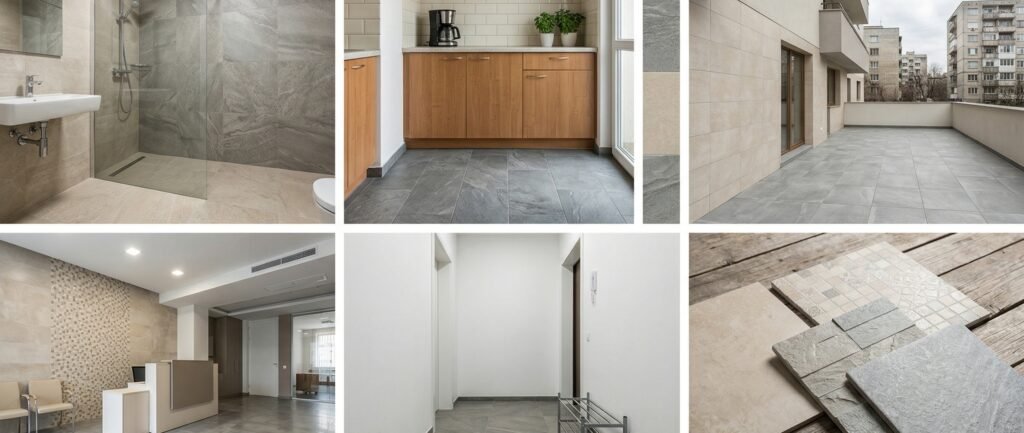
Tiles Export to Bulgaria – Definition
Tiles export to Bulgaria from India refers to the supply of ceramic, porcelain, and vitrified tiles that fully comply with the EU Construction Products Regulation (CPR 2024/3110). All tiles intended for the Bulgarian market must carry CE marking, supported by a Declaration of Performance (DoP) and tested in accordance with EN 14411 and ISO 10545 standards. Mandatory technical criteria include water absorption of ≤0.5% for porcelain tiles, frost resistance tested under EN ISO 10545-12, and full REACH compliance. Shipments are delivered via Burgas Port, Varna Port, Thessaloniki, and Constanta, and subsequently distributed across Bulgaria.
Quick Facts – Bulgaria Tile Import Market
| Parameter | Detail |
|---|---|
| Renovation-driven demand | >60% |
| Housing stock built before 1990 | >60% |
| Residential share | 65–75% |
| Commercial share | 25–35% |
| Preferred sizes | 30×60 cm, 60×60 cm, 60×120 cm |
| Porcelain water absorption | ≤0.5% |
| Frost resistance | Mandatory for outdoor tiles |
| Transit time | 30–38 days (sea) + 2–5 days inland |
| Entry ports | Burgas, Varna, Thessaloniki, Constanta |
| Market structure | >70% distributor/importer-driven |
Key Insights for Bulgaria Buyers
Key Insight: Bulgaria is a renovation-led tile market Why it matters: The country’s aging building stock creates continuous, sustained demand for tile replacement — making it a reliable long-term opportunity for Indian exporters.
Key Insight: Buyers prioritize cost-efficiency Why it matters: Purchasing decisions in Bulgaria are driven by the price-to-durability ratio rather than brand recognition, which positions Indian manufacturers competitively.
Key Insight: Frost resistance is essential Why it matters: Bulgaria regularly experiences winter temperatures as low as -15°C, making frost resistance a non-negotiable technical requirement for any outdoor tile application.
Key Insight: Contractors influence purchases Why it matters: On-site professionals heavily influence product selection. Tiles that offer installation efficiency and minimal wastage are consistently preferred.
Bulgaria Tile Market Overview
Demand Structure
The Bulgarian tile market is primarily shaped by residential renovation activity. Ceramic tiles remain dominant in this segment, while porcelain tiles represent the fastest-growing category. Vitrified tiles are widely used in commercial and infrastructure projects, reflecting a broader shift toward higher-durability materials in public and institutional spaces.
Renovation vs. New Construction
Renovation activity accounts for over 60% of total tile demand, supported in part by EU-funded building retrofit programs that continue to drive floor and wall replacement across the country. New construction activity, while smaller in overall share, remains concentrated in major urban centers — Sofia, Varna, Burgas, and Plovdiv — where residential and commercial development continues at a steady pace.
Design and Size Trends
Market preferences in Bulgaria currently lean toward stone-look, wood-look, and cement-finish surfaces, with neutral color palettes dominating across both residential and commercial projects. Large-format tiles — particularly the 60×120 cm format — are gaining significant traction as designers and contractors seek seamless, contemporary aesthetics.
Indoor vs. Outdoor Applications
Indoor applications account for approximately 75% of tile usage in Bulgaria. Outdoor installations, while a smaller segment, carry stricter technical requirements: anti-slip performance and certified frost resistance are mandatory for any exterior application given the country’s climate conditions.
Types of Tiles Exported to Bulgaria
The following tile categories are supplied from India for the Bulgarian market:
-
- Porcelain tiles (EN 14411 BIa classification)
-
- Ceramic tiles
-
- Vitrified tiles
-
- Full-body porcelain tiles
-
- Glazed vitrified tiles (GVT)
-
- Double charge vitrified tiles
Why Bulgaria Imports Tiles from India
Indian tile manufacturers offer a combination of factors that align closely with the requirements of the Bulgarian market. The strong price-to-durability ratio makes Indian products particularly well-suited to renovation-driven procurement. Bulk supply availability ensures that importers and distributors can maintain consistent inventory without interruption. Growing compliance with EU CE marking and EN standards has strengthened India’s credibility as a reliable supply origin, while the country’s capacity in large-format tile production addresses one of the market’s fastest-growing design preferences.
Compliance and Standards for Bulgaria (EU Regulations)
Exporting tiles to Bulgaria requires strict adherence to EU regulatory frameworks. Non-compliance results in market access being denied at the border.
Mandatory Requirements
-
- CE marking under CPR 2024/3110
-
- Declaration of Performance (DoP) for each product
-
- EN 14411 product classification
Technical Requirements
-
- ISO 10545 series testing across relevant performance parameters
-
- Frost resistance certification under EN ISO 10545-12
-
- Slip resistance rating to DIN 51130 (R9–R12 scale)
Environmental Requirements
-
- REACH compliance for chemical safety
-
- Environmental Product Declaration (EPD) documentation
-
- Global Warming Potential (GWP) declaration, mandatory from 2026
-
- Digital Product Passport readiness as EU sustainability requirements advance
Logistics and Shipping to Bulgaria
Shipping Routes
All sea freight from India follows the established route through the Suez Canal and into the Mediterranean before reaching European distribution ports.
Entry Points
-
- Burgas Port — primary entry point for Bulgarian-bound cargo
-
- Varna Port — secondary sea entry
-
- Thessaloniki — used for road freight connections into Bulgaria
-
- Constanta — Romania-based routing option
Transit Time
-
- Sea freight: 30–38 days
-
- Inland distribution: 2–5 days
Distribution
Sofia functions as the central distribution hub for Bulgaria. Road transport remains the dominant mode for inland delivery to regional buyers and distributors.
Packaging and Quality Assurance
Proper packaging is critical to ensuring tiles arrive in Bulgaria without damage or compliance issues. Shipments are prepared using ISPM-15 certified pallets, with full shrink wrapping and edge protection applied to each pallet. Double strapping is used to prevent movement and breakage during transit. Moisture-resistant outer packaging protects tiles against humidity during sea freight. Every batch is labeled with shade, caliber, and size references to ensure traceability and ease of inventory management. Quality inspection is conducted in accordance with ISO 10545 testing protocols.
Buyer Decision Factors in Bulgaria
Bulgarian importers and distributors evaluate tile suppliers based on a clearly defined set of criteria. Price competitiveness relative to product durability remains the primary driver. CE and EN standard compliance is a prerequisite for market entry. Frost resistance certification is essential for any outdoor or mixed-use application. Beyond product specifications, buyers place considerable weight on supply consistency, delivery reliability, and the installation efficiency that dimensionally stable, well-calibrated tiles provide.
Competitive Comparison – Bulgaria Tile Market
Country Strengths and Weaknesses
| Country | Strengths | Weaknesses |
|---|---|---|
| Turkey | Fast delivery | Limited premium positioning |
| Poland | EU compliance | Higher cost |
| China | Low pricing | Quality inconsistency |
| Italy | Premium design | High cost |
| Spain | Balanced quality | Expensive |
| India | Cost-efficient, wide product range | Longer transit time |
India vs. Turkey vs. China vs. EU Suppliers
| Factor | India | Turkey | China | EU |
|---|---|---|---|---|
| Price Competitiveness | High | High | Very High | Low |
| Quality | Medium–High | Medium | Low–Medium | High |
| Lead Time | Medium | Fast | Slow | Very Fast |
| Compliance | Strong (CE/EN) | Strong | Variable | Strong |
About Scalane International
Scalane International is an established exporter of ceramic, porcelain, and vitrified tiles from India, with a focused specialization in EU-compliant exports. The company serves Bulgaria and the broader Eastern European market like Ireland, Finland, Austria with an operational emphasis on bulk supply capability and shipment consistency.
Why Choose Scalane International
-
- CE-marked and EN 14411 compliant tile range
-
- Products tested and certified under ISO 10545 standards
-
- Specialized expertise in frost-resistant tile solutions for EU climates
-
- Robust packaging and logistics processes designed for long-haul sea freight
-
- Proven capability in consistent, large-volume export supply
Trust and Risk Reduction
Scalane International provides a Declaration of Performance with each product, along with third-party testing reports to substantiate compliance claims. Sample shipments are available prior to bulk orders, and full batch traceability is maintained throughout the supply chain. The company’s established EU export experience ensures that documentation, labeling, and regulatory requirements are handled accurately at every stage.
E-E-A-T — Expertise and Authority
The content and supply practices of Scalane International are grounded in direct expertise across EU construction product regulations, including CPR, EN standards, and evolving sustainability requirements. The company’s experience in Bulgaria-specific tile exports — covering frost resistance, large-format supply, and renovation project sourcing — reflects technical depth rather than general market knowledge. All compliance documentation is maintained transparently and made available to buyers as part of the standard export process.
FAQ – Tiles Export to Bulgaria
Can tiles be exported from India to Bulgaria? Yes. Tiles can be legally exported from India to Bulgaria provided they comply with CE marking requirements, EN 14411 classification, and CPR 2024/3110 regulations.
What is CE marking for tiles? CE marking is a mandatory EU conformity indicator confirming that a product meets the applicable safety, durability, and performance standards required for market placement within the European Union.
Which EN standard applies to tiles? EN 14411 is the primary standard, defining the classification system and technical performance requirements for ceramic and porcelain tiles used in EU markets.
What tests are required under ISO 10545? The ISO 10545 series covers a range of performance tests including water absorption, modulus of rupture, frost resistance, and chemical resistance, among others.
Is frost resistance mandatory in Bulgaria? Yes. Any tile intended for outdoor use in Bulgaria must comply with EN ISO 10545-12, given the country’s sub-zero winter temperatures.
What is the water absorption limit for porcelain tiles? Porcelain tiles classified under EN 14411 BIa must demonstrate water absorption of ≤0.5%.
What documents are required for export? Required documentation includes CE marking certification, Declaration of Performance, commercial invoice, packing list, and applicable ISO 10545 test reports.
What is the shipping time to Bulgaria? Sea freight transit from India takes 30–38 days, with an additional 2–5 days for inland delivery within Bulgaria.
Which ports are used in Bulgaria? Burgas and Varna are the primary sea entry ports. Thessaloniki (Greece) and Constanta (Romania) serve as alternative routing points with onward road freight into Bulgaria.
What packaging is required for EU export? Shipments must use ISPM-15 certified wooden pallets, with shrink wrapping, edge protection, and moisture-resistant outer packaging applied as standard.
How do Bulgarian buyers select suppliers? Buyers evaluate suppliers based on regulatory compliance, price competitiveness, product durability, and the reliability of supply across repeat orders.
Are anti-slip tiles required? Yes. Tiles used in applicable areas must carry DIN 51130 anti-slip ratings, typically ranging from R9 to R12, depending on the specific application.
What makes Indian tiles competitive in Bulgaria? Indian tiles offer a strong combination of technical performance and cost efficiency, supported by a wide product range that covers both standard and large-format sizes.
What durability factors matter most? The most critical performance indicators are low water absorption, high modulus of rupture, and certified frost resistance — all of which directly affect long-term tile performance in Bulgarian conditions.
What installation factors are important? Dimensional consistency and accurate calibration are essential. Tiles with stable sizing reduce on-site cutting, lower material wastage, and improve overall installation efficiency.
 Start Your Bulgaria Tile Import Process
Connect with Scalane International export specialists
Request CE-certified tile catalog
Get samples for testing and approval
Discuss bulk order requirements