Scalane International is a trusted tiles exporter to Germany, delivering precision-engineered ceramic, porcelain, and vitrified tiles that meet strict EU and German standards.
We supply high-performance tiles for Germany’s residential and commercial markets, ensuring full compliance, consistent quality, and reliable logistics.
What Does Tiles Export to Germany Mean?
Exporting tiles from India to Germany involves more than simply shipping a product across borders. It means supplying ceramic, porcelain, vitrified, and GVT/PGVT tiles that fully comply with EU regulatory requirements — including CE marking, EN 14411, and the EU Construction Products Regulation (CPR).
German buyers expect rectified, precision-cut tiles with tight dimensional tolerances. There is strong demand for frost-resistant, anti-slip, and large-format formats, driven by both residential renovation projects and large-scale commercial developments. The supply chain typically runs from manufacturer to importer, then onward to distributor or project site — and quality must hold at every stage.
Germany Tile Market Overview
Germany is one of Europe’s most demanding tile markets. Compliance is non-negotiable, and consistency is expected as standard.
Market Highlights
Renovation work drives the majority of demand, accounting for 70–75% of total tile consumption. Porcelain tiles and large formats dominate specifications, while outdoor anti-slip tiles — rated R10 to R12 — are seeing strong growth. Tiles compatible with underfloor heating systems are also increasingly specified across both residential and commercial projects.
Popular Applications
German contractors and developers use tiles extensively across a wide range of settings:
Residential: Bathrooms, kitchens, and living spaces Commercial: Offices, retail environments, hospitality venues, and public infrastructure
Design Trends
Current preferences lean toward concrete and stone looks, wood plank tiles, and matte finishes. Neutral tones — particularly grey, beige, and anthracite — remain the dominant palette across both residential and commercial segments.
Types of Tiles Exported to Germany
Ceramic Tiles
Ceramic tiles are widely used for wall applications and light-use flooring. They offer a cost-effective solution for residential projects and remain a consistent part of the export mix.
 Explore: Ceramic Tiles Collection
Porcelain Tiles
Porcelain tiles are the most demanded category in the German market. Their low water absorption and frost-resistant properties make them suitable for both indoor and outdoor use — a key advantage in Germany’s climate.
Explore: Porcelain Tiles Export
Vitrified Tiles
Known for their high strength and long-term durability, vitrified tiles are well-suited to commercial applications where performance under heavy foot traffic is essential.
GVT / PGVT Tiles
Glazed and polished glazed vitrified tiles combine technical performance with sophisticated aesthetics. With digitally printed surfaces that replicate marble, wood, and natural stone, they are increasingly specified in modern interior projects across Germany.
Explore: GVT / PGVT Tiles
Why Germany Imports Tiles from India
India has established a strong position as a tile supplier to European markets — and Germany is no exception. The key advantages are well understood by experienced importers:
-
- A compelling cost-to-quality ratio that is difficult to match
-
- Large-scale manufacturing capacity capable of handling significant project volumes
-
- Proven expertise in large-format tiles, including sizes of 1200×2400 mm and beyond
-
- Growing alignment with EU compliance requirements
-
- Reliable bulk supply with export-ready logistics
Tiles exporter to Germany – Compliance & Standards
Meeting German and EU compliance requirements is not optional — it is the baseline for market entry.
CE Marking
CE marking is mandatory for all tiles sold in Germany. It is based on EN 14411 and requires a Declaration of Performance (DoP) to be issued by the manufacturer.
EN & ISO Standards
Tiles exported to Germany must meet the requirements of EN 14411 for tile classification, along with ISO 10545 test protocols covering water absorption, abrasion resistance, breaking strength, and frost resistance.
DIN Standards (Germany)
Germany applies additional national standards on top of EU requirements. DIN 51130 governs slip resistance, with ratings from R9 to R13. DIN 51097 applies to wet barefoot areas, using an A, B, C classification system.
Additional Compliance
Exporters supplying the German market should also be prepared to address the EU Construction Products Regulation (CPR), Environmental Product Declarations (EPDs), REACH compliance for chemical substances, and registration under the German Packaging Act (VerpackG / LUCID).
Learn More: EU Tile Compliance Guide
Quality & Precision Standards
German buyers apply engineering-level expectations to tile procurement. Quality is evaluated not just on appearance, but on measurable technical performance.
Key Requirements
Dimensional tolerance must be within 0.5 mm. Rectified edges are considered standard, not a premium. Surface flatness must be consistent across the batch, and first-choice grading is mandatory — no grade mixing is acceptable.
Technical Performance
Buyers will assess breaking strength, modulus of rupture, slip resistance ratings, and water absorption figures. Each of these must be supported by third-party test documentation.
Batch Consistency
Shade consistency is declared using V-ratings, and calibration must be uniform across the entire consignment. German buyers expect the bulk delivery to match the approved sample — without exception.
Logistics & Shipping to Germany
Shipping Routes
Most shipments from India to Germany depart from Mundra or Nhava Sheva and arrive at Hamburg or Bremerhaven. Rotterdam is also used as an alternative entry point, with onward distribution into Germany by road or rail.
Transit Time
Standard transit times run between 25 and 40 days depending on routing and port conditions.
Delivery Options
Scalane International can ship on FOB, CIF, or DDP terms. DDP is the preferred option for most German buyers, as it simplifies customs clearance and reduces the administrative burden on the importer.
Inland Distribution
Germany’s well-developed rail and road network supports fast, efficient distribution to project sites across the country and into neighbouring EU markets.
Packaging & Quality Assurance
Packaging Standards
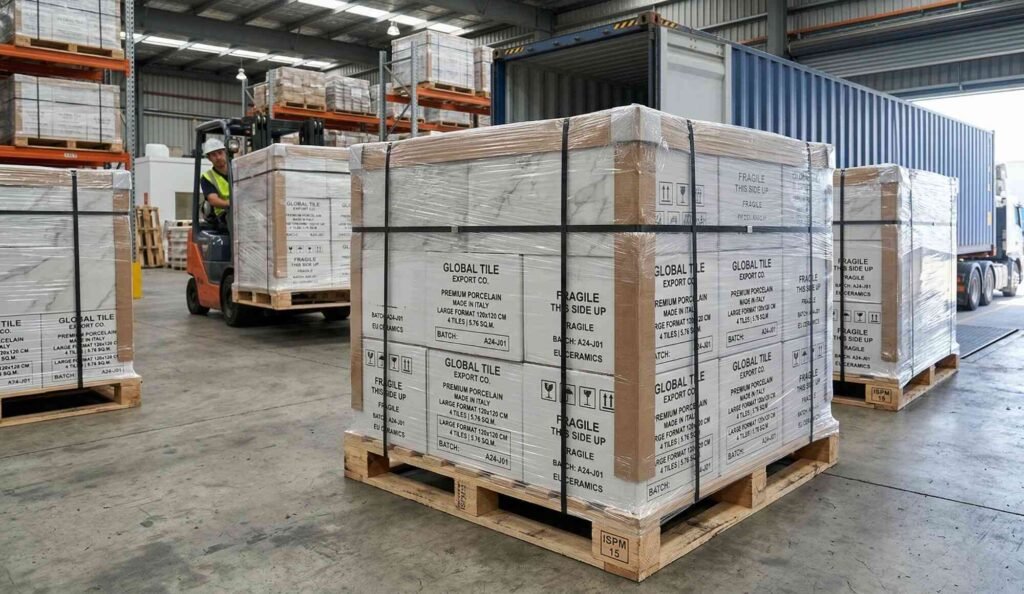
All shipments are packed on Euro pallets (800×1200 mm) using strong corrugated boxes with shrink wrapping and strapping applied throughout.
Damage Prevention
Corner protection is applied to all pallets, and moisture-resistant packaging is used as standard. Handling protocols are designed to eliminate transit damage.
Quality Assurance
Pre-shipment inspections are carried out on every consignment. Batch-wise test reports are provided, and calibration and shade checks are completed before loading.
Learn More: Tile Export Packaging Guide
Buyer Decision Factors
What German Buyers Evaluate
German importers and procurement teams are thorough in their supplier assessments. They will review the Technical Data Sheet (TDS) in detail, verify CE marking and DoP documentation, and check for EPD availability on sustainable projects. Consistent quality and reliable delivery timelines are weighted heavily in any supplier evaluation.
Key Concerns
The concerns that most often cause German buyers to switch suppliers — or walk away entirely — are quality inconsistency, compliance gaps, shipping damage, and uncertainty about long-term supplier reliability. Addressing these proactively, with documentation and audit trails, is what separates credible exporters from the rest.
Competitive Comparison
| Country | Strength | Weakness |
|---|---|---|
| Germany | Premium quality | High cost |
| Italy | Design leadership | Expensive |
| Spain | Balanced quality | Limited low-cost options |
| Turkey | Proximity to Europe | Quality variation |
| India | Cost + scale + large format | Perception gap |
About Scalane International
Scalane International is a dedicated tiles supplier to Germany, combining export-grade manufacturing with structured compliance support for European buyers.
Our Expertise
The company focuses on European export markets like Germany, Portugal, Poland, Belgium with specialist capability in large-format tile manufacturing, compliance-driven production, and full technical documentation support.
Why Choose Scalane International
Scalane International offers CE-compliant manufacturing, rigorous quality control, consistent batch production, export-ready packaging, and dependable logistics — the full package that German buyers expect from a serious long-term partner.
Trust & Reliability
Every shipment is backed by CE marking and full documentation, batch-level testing records, confirmed sample-to-bulk consistency, and a strong track record across international export markets.
Frequently Asked Questions (FAQ)
Can tiles be imported to Germany from India? Yes. Tiles can be imported from India provided they carry CE marking, comply with EN 14411, and are accompanied by a valid Declaration of Performance (DoP).
What EU regulations apply to tile imports in Germany? Tiles must comply with the Construction Products Regulation (CPR), CE marking requirements, the relevant EN standards, and REACH regulations for chemical substances.
Is CE marking mandatory for tiles in Germany? Yes. CE marking is mandatory for all tiles placed on the German market.
What DIN standards are required? DIN 51130 (R9–R13 slip resistance ratings) and DIN 51097 (A, B, C ratings for wet barefoot areas) are the primary German standards applicable to tile exports.
What tests are required for tiles? ISO 10545 testing is required, covering water absorption, abrasion resistance, breaking strength, and frost resistance.
What documents are required? The standard documentation set includes a DoP, CE certificate, Technical Data Sheet, test reports, commercial invoice, and packing list.
What is the shipping time? Typically 25 to 40 days from Indian ports to Hamburg or Bremerhaven.
Which ports are used? Hamburg and Bremerhaven are the primary entry ports. Rotterdam is used as an alternative, with onward distribution into Germany.
What packaging is required? Euro pallets, heavy-duty corrugated boxes, shrink wrapping, strapping, and protective corner packaging are all standard requirements.
What is VerpackG? VerpackG is Germany’s packaging law. Exporters supplying the German market are required to register under the LUCID system.
How important is quality consistency? It is critical. German buyers operate with zero tolerance for defects or batch variation.
What do buyers look for in suppliers? Compliance documentation, product consistency, on-time delivery, and the confidence that the bulk supply will match the approved sample.
Are EPDs required? Environmental Product Declarations are increasingly required for projects with sustainability specifications and are becoming standard practice in the German market.
Which tiles are in demand? Porcelain tiles, large-format rectified tiles, outdoor anti-slip tiles, and GVT/PGVT designs are all in strong demand across Germany.
How to reduce import risk? Partner with certified, experienced exporters, request full batch test reports, and ensure pre-shipment inspections are carried out before goods leave the factory.
 Start Your Tile Import from India to Germany
Request a Product Catalog · Get Free Samples · Request Technical Datasheets · Speak with an Export Expert
Partner with Scalane International – your trusted tiles exporter to Germany.