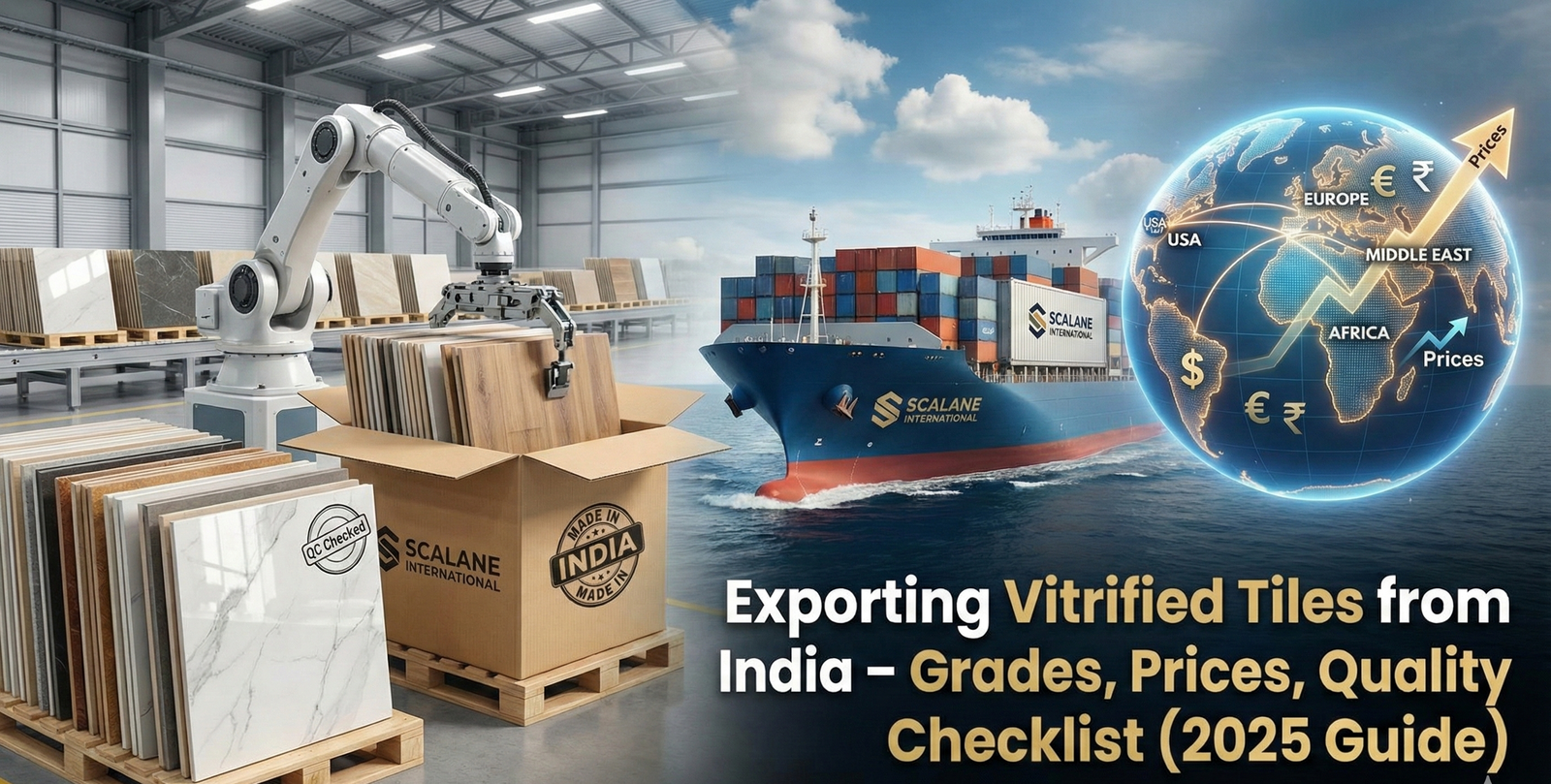
Welcome to the definitive 2025 guide for exporting vitrified tiles from India — written with the clarity, depth, and business-savvy approach you’d expect from someone with 15+ years of export marketing experience. If you’re an importer, distributor, construction company, or flooring retailer looking to source high-quality vitrified tiles in bulk, this blog gives you everything you need: from tile grades and technical specs to FOB pricing, container logistics, quality checklist, and a comparison of global competitors. Exporting vitrified tiles from India has become a major trend in 2025 as global demand rises.
Whether you’re sourcing from Scalane International or any other Indian manufacturer, treat this as your “export bible” for 2025.
Why Vitrified Tiles from India Are in High Demand
- A booming global market. The global vitrified tiles market is estimated to be between USD 102–543 billion in 2025, with a projected CAGR of 3.07–4.97% through 2035. Demand is rising steadily — especially for durable, low-maintenance flooring options in residential, retail, and commercial projects.
- India’s rising leadership. India is now the second-largest ceramic tile exporter globally (after China), having exported 1.3 billion square meters in 2024, and growing 10–12 % in 2025. In 2023, exports hit 589 million m², with export value exceeding €2.25 billion. Vitrified tiles – prized for durability and low water absorption – represent the highest-value segment within Indian ceramic exports.
- Why buyers prefer vitrified tiles. Vitrified tiles offer superior strength, lower water absorption (< 0.5%), and a polished or matte finish that suits modern aesthetics. This makes them ideal for floors in residential, commercial and high-traffic areas — increasing their demand worldwide.
- Fast-growing markets. Emerging import markets for Indian tiles include Israel (+146 %), Mexico (+128 %), Russia (+128 %), South Africa (+123 %), and Chile (+67 %). Meanwhile, North America and Asia-Pacific remain enduring demand hotspots, accounting for the majority of floor tile imports.
- India’s competitive edge. Compared with premium-design markets (e.g., Italy, Spain), Indian exporters offer strong value-for-money: high durability, comparable finishes, and competitive pricing — making India especially attractive for bulk buyers. The rising global demand makes exporting vitrified tiles from India a strategic advantage for buyers who want reliable quality and competitive prices.
All of this makes 2025 a favorable time for international buyers to import vitrified tiles from India. When exporting vitrified tiles from India, importers must evaluate QC, packing, FOB pricing, and shipping schedules carefully.
Understanding Tile Grades, Types & Technical Specifications
To import vitrified tiles intelligently and avoid costly mistakes, buyers must know tile grades, types, finishes, sizes, and technical specs. Below is a comprehensive breakdown.
First / Second / Third Grade: What They Mean
| Grade | Definition & Quality Standards | Typical Use |
|---|---|---|
| First Grade (Grade A / First Quality) | > 95% defect-free; no visible cracks, color variation, or edge defects; consistent thickness, water absorption < 0.5%. | Premium projects (hotels, luxury homes, showrooms) |
| Second Grade (Grade B / Second Quality) | Minor aesthetic defects permitted (e.g., tiny glaze specks, slight shade variation, imperceptible edge irregularities < 3 mm). Functionally sound. | Budget-conscious projects, large area flooring where small variations are acceptable. |
| Third Grade (Grade C / Utility Grade) | Functional tiles with visible defects, glaze or surface imperfections, inconsistent thickness or glaze coverage; primarily used where aesthetics are unimportant (e.g., warehouses, temporary constructions). | Utility or temporary flooring. |
Note: The 1st vs 2nd grade difference typically commands a 25–40% premium for First Grade — a major factor in FOB pricing.
Exporting Vitrified Tiles from India – What Importers Must Know
- Full-Body (Porcelain) Vitrified Tiles: Entire body is colored uniformly; glaze-free. High durability, low wear; ideal for heavy-traffic commercial use. Gaining market share globally due to long lifespan and consistency.
- Double-Charge Vitrified Tiles (DCVT): Two layers — body + color charge. Strong and cost-effective; widely used in volume exporting.
- Glazed Vitrified Tiles (GVT / PGVT / Polished Glazed): Color + glaze layer; available in glossy/polished finishes — popular for premium residential and retail projects.
- Glazed Porcelain Vitrified Tiles: Combines porcelain’s strong body with glazed surface finishing; commands a price premium (≈25–30%).
Sizes, Thickness & Finishes in Demand (2025)
| Size | Common Use | Popular Thickness | Typical Finish |
|---|---|---|---|
| 600×600 mm (2×2 ft) | Residential, small commercial floors | 8–10 mm | Matte or Glossy |
| 600×1200 mm (2×4 ft) | Larger residential / commercial floors | 9–10 mm | Glossy / Matte / Digital texture |
| 800×800 mm | Mid-size floor projects | 10–12 mm | Matte / Glossy |
| 800×1600 mm (Large Format) | High-end villas, luxury hotels, commercial lobbies | 10–12 mm | Glossy / Matte / Digital / 3D |
- Thickness preference: 9–10 mm is standard for residential; 10–12 mm for commercial & high-traffic floors.
- Finish preferences (2025): Matte — 55% (slip-resistant, modern aesthetic); Glossy — 40% (premium look); Digital / 3D textures — ~5% (emerging trend).
- Water absorption (WA): Vitrified tiles exported from India must meet WA ≤ 0.5% (per ISO standard for vitrified tiles).
- Durability rating / PEI: Full-body tiles often exceed PEI 4–5, suited for heavy traffic (commercial).
Export Process – From Order to Delivery
Understanding the export workflow helps buyers plan better — from order confirmation to delivery at destination port.
- Order & Confirmation
· Sample request — most suppliers (including Scalane International) offer 4-piece test samples (buyer pays sample cost + shipping).
· Final order quantities, tile type, size, grade, finish, color, & payment terms (LC / TT / DP) are finalized before production.
· Once approved, production schedules begin — typically 4–6 weeks production lead time. Exporting vitrified tiles from India is becoming increasingly important for importers in 2025 due to rising global demand. - Quality Control & Inspection
· Tiles are inspected for water absorption (WA ≤ 0.5%), glaze uniformity, thickness, edge finishing, color consistency, and defects.
· Many buyers (or exporters like Scalane International) use third-party QC agencies — especially for First Grade exports — to ensure 95%+ defect-free consistency. Many international importers rely on exporting vitrified tiles from India because Indian manufacturers provide consistent First Grade quality at competitive FOB pricing. External Reference: https://www.iso.org/standard/67529.html - Packaging & Palletization
· Individual tiles wrapped in bubble wrap, grouped into foam-lined corrugated boxes Before exporting vitrified tiles from India, suppliers must ensure proper QC, packing, and documentation so that buyers receive damage-free shipments.. For example:- 600×600 mm — 4 pieces/box (~1.44 m², ~25.5 kg)
- 600×1200 mm — 2 pieces/box (~1.44 m², ~27 kg)
· Boxes are stacked on wooden pallets; standard pallet loads ~40–42 boxes; ~21–24 pallets per 20ft container (max stacking height ~2.5 m). Moisture-resistant liners & corner protection materials are mandatory — especially for monsoon-season shipments. If you are exporting vitrified tiles from India, Scalane International provides consistent First Grade quality and competitive FOB pricing. When exporting vitrified tiles from India, it is essential to verify QC reports, packing strength, and container loading before shipment.
- Container Loading & Logistics
- 20ft container capacity: 800–960 boxes; 1,270–1,450 m²; net weight 18–27 metric tons.
- 40ft container capacity: 1,700–2,100 boxes; 2,400–2,900 m²; net weight 25–30 metric tons.
- Freight to major markets:
- 20ft FCL: USD 2,500–4,500
- 40ft FCL: USD 4,500–7,500
- Shipping times:
- Middle East: 15–20 days
- Europe: 25–30 days
- USA (East Coast): 30–35 days
- Total payment-to-delivery cycle typically 60–90 days. Expedited orders (45 days) may carry 10–15% premium. Proper container planning is essential when exporting vitrified tiles from India, as optimizing pallets and weight limits reduces damage and freight cost.
- Documentation & Export Compliance
- Tiles must carry correct HS Codes (6907 / 6908), batch number, quality grade, and country of origin on each carton.
- Export certificates — e.g., compliance with ISO 13006, ISO 9001:2015, EN 14411, CE marking — should be provided for buyers requiring certifications.
- Proper documentation is critical to avoid customs delays (common pain point).
- Delivery & Post-Delivery Quality Check
- Once containers reach port and are cleared, buyers should immediately inspect for breakage or shade variation.
- Typical breakage rate during transit is 2–4% — having good packing standards and inspection protocols helps manage disputes.
Buyer Pain Points & How We Solve Them — Scalane International Approach
Importers worldwide face recurring issues when sourcing vitrified tiles from India. Below are some of the most common pain points — and how Scalane International addresses them proactively.
| Pain Point | Impact on Buyer | Scalane International’s Solution |
|---|---|---|
| Quality consistency variance (shade variation; grade mix within container) | Mixed grade delivery, customer complaints, installation delays | Strict internal QC + third-party QC; only First Grade tiles certified; shade-batch matching enforced; full-body porcelain standard on premium orders. |
| Breakage during transit (2–4% typical) | Loss, dispute, delays, higher re-order cost | Premium packaging — bubble wrap + foam-lined boxes + moisture-resistant liners + strong wooden pallets; corner/edge protection; proper container loading layout. |
| Documentation delays / missing certificates | Customs hold-ups, clearance delays 7–14 days | Ensure full documentation (HS code, batch number, grade, country origin, quality certificates) ready before shipment; pre-shipment checklist finalized on both sides. |
| Edge polishing / surface gloss inconsistency on polished tiles | Poor finish on installation, reduced aesthetics | Strict post-polishing inspection; glaze uniformity & edge check; only delivery after QC clearance. |
| Anti-dumping duty exposure in key markets (EU, USA, Vietnam etc.) | Sudden increase in landed cost (15–25%) → margins shrink | Early communication about regulatory changes; help buyers project landed cost with duties; offer alternate products (e.g., full-body tiles) which may have lower duty impact or better duty classification. |
| Monsoon-season supply chain delays & moisture damage risk | Delivery delays by 2–3 weeks; tile damage due to humidity | Use of moisture-resistant packaging; shipping scheduling mindful of monsoon; storing inventories in dry warehouses; more flexible lead-time commitments. |
| Unclear MOQ / container loading inefficiency | Higher per-unit cost; waste of container space | Offering LCL consolidation for small buyers, optimizing pallet stacking & container loading to maximize sqm per container. |
Because Scalane International anticipates and mitigates these risks, importers get consistent First Grade quality, minimal damage, transparent documentation, and on-time delivery — making us a trusted partner for bulk vitrified tile sourcing from India in 2025. The overall success of exporting vitrified tiles from India depends on strong quality control, accurate shade matching, and reliable container loading practices.
Competitor Comparison: India vs China vs Spain vs Italy vs Turkey
When importing vitrified tiles, you’re not just buying from India — you’re competing with suppliers globally. Here’s a strategic comparison of major tile-exporting countries (as of 2025):
| Country / Region | Typical Market Position | Price Range vs India | Strengths | Weaknesses |
|---|---|---|---|---|
| India (e.g., Scalane International) | Value-driven, cost-effective, quality-for-cost balance | Baseline | Strong price-to-quality ratio; large production capacity; MOQ & bulk discounts; diverse finishes and sizes | Some enforcement needed for consistent QC; less “design luxury” vs EU producers |
| China | Mass-market, budget / volume tiles | 15–25% below India | Extremely competitive pricing; volume leader (~49.7% global production) | Quality consistency issues, less design innovation; glaze/finish variability; higher breakage risk. |
| Turkey | Mid-tier volume tiles, closer to India | 5–10% below India | Good design variety; logistics advantage to Europe & Middle East; competitive pricing for volume tiles | Less global brand presence; limited premium-premium offerings; quality slightly below high-end European standards. |
| Spain | Premium, design-driven collections, high-end finishes | 20–35% above India | Intricate patterns, trend-forward aesthetics; strong brand for luxury interiors | High cost limits penetration in price-sensitive markets; less competitive on bulk/volume orders. |
| Italy | Luxury / high-end segment, marble-look, premium interiors | 25–40% above India | Top-tier quality; iconic marble & natural-stone aesthetics; strong sustainability and design credentials | Cost-prohibitive for bulk/construction markets; long lead times; rigid design catalog (less customization flexibility). |
Bottom line for importers: If you’re sourcing for bulk flooring needs — residential projects, hotels, retail outlets, commercial buildings — India offers the best balance of price, quality, logisitics, and scalability. For ultra-luxury or designer-driven projects, European suppliers may still make sense — but at significantly higher landed costs. For anyone exporting vitrified tiles from India in 2025, Scalane International offers the best combination of First Grade quality and competitive pricing. Most international partners prefer exporting vitrified tiles from India because Scalane International provides strict QC, accurate shade control, and dependable shipping timelines.
With Scalane International, you get Indian cost efficiency without sacrificing First Grade quality — making it a compelling choice for global buyers.
Frequently Asked Questions (FAQ)
Q1: What is a vitrified tile made of?
A: Vitrified tiles are ceramic tiles fired at very high temperatures to create a glass-like, non-porous, dense body. They can be full-body porcelain (colored through the body), double-charge, or glazed. The vitrification process reduces water absorption (typically < 0.5%), increases hardness, and improves durability — making them ideal for high-traffic floors.
Q2: Are vitrified tiles waterproof?
A: While no tile is 100% “waterproof,” vitrified tiles have very low water absorption — usually < 0.5%. This means they resist water penetration much better than regular ceramic tiles and are suitable for bathrooms, kitchens, commercial lobbies, and even outdoor covered spaces (provided proper grout/sealant).
Q3: How durable are vitrified tiles?
A: Vitrified tiles — especially full-body porcelain — offer high hardness, resistance to wear, low porosity, and high load-bearing capacity. With proper installation and maintenance, their lifespan can exceed 20–25 years, even in heavy-traffic commercial settings.
Q4: What is the difference between vitrified, ceramic, and porcelain tiles?
A:
- Ceramic tiles: Made from clay, often glazed; higher porosity; water absorption > 3–5%; less durable; lower cost.
- Vitrified tiles: Fired at higher temperatures; dense, low-porosity body; water absorption < 0.5%; stronger and more durable.
- Porcelain vitrified tiles (full-body): Type of vitrified tile with uniform body color; no glaze; among most durable and long-lasting floor tiles.
Q5: Vitrified vs porcelain tiles — which is better?
A: The term “porcelain vitrified tile” refers to a sub-type of vitrified tile. If you compare a glazed ceramic tile vs a full-body porcelain vitrified tile, for durability, water resistance, and longevity — porcelain vitrified is far superior. For cost, glazed vitrified or DCVT may be more economical.
Q6: What is water absorption in tiles, and why does it matter?
A: Water absorption (WA) is the percentage of water a tile absorbs under standardized testing (often ISO 13006). Lower WA (< 0.5%) means tile is more resistant to moisture, less prone to staining or frost damage (in cold climates), and better for wet areas (bathrooms, kitchens).
Q7: How to check tile quality before importing?
A: Ask supplier for: WA test certificates, PEI rating (for wear resistance), batch photos, glaze/uniformity inspection reports, box/pallet photos, full specifications (size, thickness, finish), and third-party QC inspection (if possible). Always request sample pieces before final order, ideally 4–6 tiles.
Q8: What is Grade A and Grade B tiles?
A: “Grade A” (First Grade) means ≤ 5% defects — virtually no visible flaws, consistent color/shade, uniform thickness, good edge finishing. “Grade B” (Second Grade) may have minor cosmetic imperfections — acceptable for less visible or high-volume flooring projects.
Q9: Are vitrified tiles suitable for bathrooms?
A: Yes — especially with a matte or anti-slip finish. Because water absorption is minimal and surface is dense, vitrified tiles resist water, stains, and moisture expansion — making them very suitable for bathrooms and kitchens.
Q10: What is the lifespan of vitrified tiles?
A: With proper installation and maintenance, vitrified tiles can last 20–25 years or more, especially full-body tiles in low-to-medium traffic areas. Commercial-grade tiles can endure even longer under heavy wear.
Q11: How to prevent tile breakage during shipping?
A: Ensure careful packing (bubble wrap + foam lining), strong cardboard boxes, corner/edge protection, moisture-resistant liners, sturdy wooden pallets, balanced container loading, and minimise container overloading. Also, request packing photos and container loading layout plan from exporter.
Q12: What certifications matter for tile export?
A: Key certifications/import requirements often include: ISO 13006 (vitrified / porcelain tile standard), ISO 9001:2015 (quality management), EN 14411, and CE marking (for European import). Exporters who comply with these standards — and provide documentation — reduce customs risk and simplify approvals.
Q13: How long does tile export take from India?
A: Typically 60–90 days from order confirmation to delivery at destination port. For expedited service, 45-day delivery is possible (with 10–15% premium). This includes production (4–6 weeks), loading, sea freight, and customs clearance.
Q14: What does FOB price mean for tiles?
A: FOB (Free on Board) price refers to the cost of tiles loaded on the ship at the Indian port (e.g., Mundra or Nhava Sheva). It includes production, packaging, and port loading charges — but not sea freight, insurance, customs duties, inland transport, or unloading at the destination. Importers must add freight, duties, and delivery costs to calculate CIF/landed cost.
Q15: Which countries import most tiles from India?
A: Key import markets include North America, Asia-Pacific countries, Middle East, and rapidly growing markets like Israel, Mexico, Russia, South Africa, Chile, among others. Emerging demand in Latin America, Africa, and the Middle East is growing fast.
How to Get Started – Next Steps
If you’re ready to import vitrified tiles in bulk, here’s how to begin with Scalane International:
- Request a free sample pack (4–6 tiles) to test water absorption, finish, thickness, shade consistency.
- Share your required tile type, size, finish, grade, and quantity — we’ll provide FOB quotation + estimated CIF landed cost.
- Upon order confirmation, we’ll begin production, schedule third-party QC (if needed), pack carefully, and ship via 20ft/40ft FCL or LCL consolidators depending on your MOQ.
- Receive packing photos, container loading plan, Bill of Lading, and all export documentation.
- Enjoy consistent First Grade quality, timely delivery, and excellent value — ready for distribution or installation.
👉 Get started now: Visit our product catalog for porcelain vitrified tiles — Scalane International Porcelain Vitrified Tiles
Or contact us directly for custom quotes, export pricing lists, sample requests, and container scheduling.