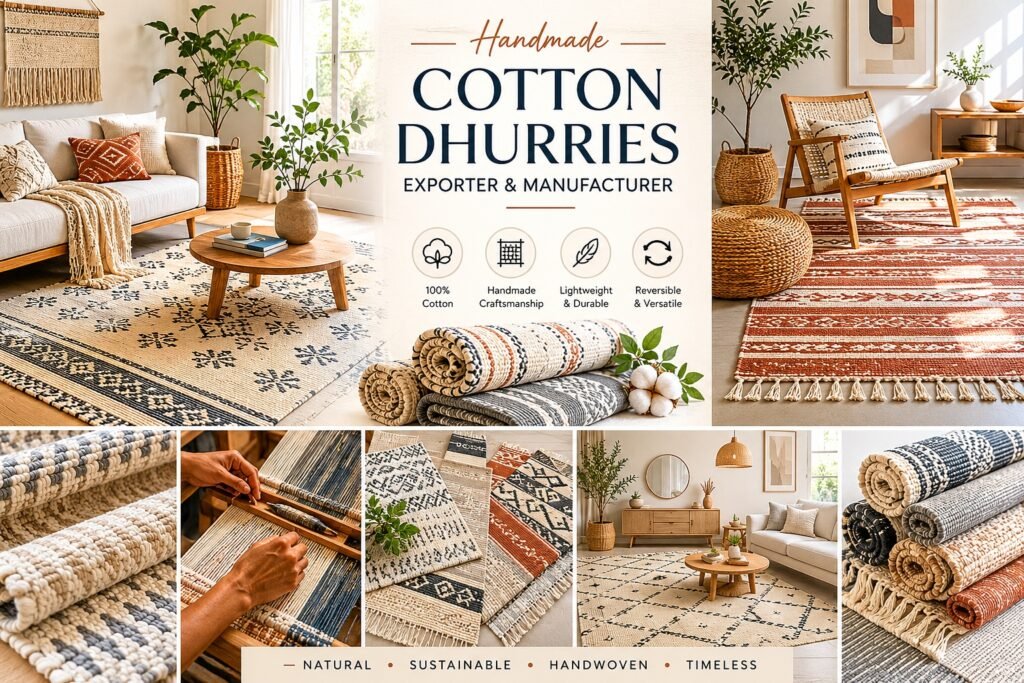
Scalane International supplies cotton dhurries and flatweave cotton rugs from India for importers, wholesalers, retailers, home décor businesses and interior projects.
Our cotton dhurrie manufacturing covers different sizes, colours, patterns, weaving structures and finishing specifications according to buyer requirements.
Cotton dhurries are lightweight, low-profile woven floor coverings that can be used across residential, retail, hospitality and other interior applications. Depending on the construction and specification, they can be developed as reversible, washable or custom-designed products.
For international buyers, we support the sourcing process from product specification and sampling through production coordination, quality inspection, packing and export preparation.
What Are Cotton Dhurries?
Cotton dhurries are flatwoven floor coverings made using cotton yarns. Unlike pile rugs, their surface is created through the interlacing of warp and weft yarns, producing a relatively flat and lightweight construction.
Their construction makes cotton dhurries suitable for buyers looking for:
- Lightweight floor coverings
- Low-profile woven rugs
- Reversible designs
- Easy storage and handling
- Custom colours and patterns
- Contemporary and traditional designs
- Retail and wholesale rug collections
The exact characteristics of a cotton dhurrie depend on its yarn, weave, dimensions, pattern and finishing.
Cotton Dhurrie Features
| Feature | Buyer consideration |
|---|---|
| Flatwoven construction | Low-profile and lightweight |
| Cotton yarn | Natural textile material |
| Reversible construction | Some designs can be used on both sides |
| Foldable format | Convenient for storage and transport |
| Custom colours | Suitable for collection development |
| Custom patterns | Supports different design requirements |
| Lightweight structure | Practical for handling and shipping |
| Low pile or no pile | Suitable for selected interior applications |
Not every cotton dhurrie has the same construction or performance characteristics, so specifications should be confirmed for each product.
Flatweave Cotton Rugs and Dhurries
Flatweave cotton rugs are produced by interlacing yarns rather than building a raised pile.
This construction can provide a lightweight product with a relatively flat surface and woven appearance.
Depending on the product specification, cotton flatweave rugs can be developed in:
- Solid colours
- Stripes
- Geometric patterns
- Traditional motifs
- Contemporary designs
- Textured woven patterns
- Neutral colour palettes
- Custom artwork
The appropriate weaving method depends on the design, size, quantity and production requirements.
Cotton Dhurrie Manufacturing in India
Cotton dhurrie manufacturing involves several stages, from yarn preparation to weaving and finishing.
A typical production process includes:
1. Product Specification
The buyer’s requirements are established for:
- Material
- Size
- Colour
- Pattern
- Construction
- Quantity
- Finishing
- Packaging
2. Yarn Preparation
Cotton yarn is prepared according to the required colour, construction and product specification.
3. Weaving
Warp and weft yarns are interlaced according to the selected weaving structure and design.
4. Pattern Development
Where applicable, patterns, stripes, geometric arrangements or other design elements are incorporated during the weaving process.
5. Finishing
Depending on the product, finishing may include:
- Washing
- Drying
- Trimming
- Edge finishing
- Surface cleaning
- Dimensional checking
6. Quality Inspection
Finished dhurries are checked against the agreed product specifications.
7. Packing
The finished products are folded, packed and prepared according to the shipment and buyer requirements.
Types of Cotton Dhurries
Cotton dhurries can be developed in different styles and constructions according to the target collection.
Flatweave Cotton Dhurries
Low-profile woven floor coverings suitable for buyers seeking lightweight cotton rugs.
Handmade Cotton Dhurries
Handwoven cotton dhurries can provide variations in texture and appearance associated with handmade production.
Reversible Cotton Dhurries
Selected flatwoven constructions can be designed for use on both sides, depending on the pattern and finishing.
Geometric Cotton Dhurries
Geometric patterns can include stripes, grids, diamonds and other repeat designs.
Contemporary Cotton Dhurries
Modern colour combinations, simple patterns and clean woven textures can be developed for contemporary interiors.
Traditional Cotton Dhurries
Traditional-inspired patterns can be developed according to the buyer’s collection requirements.
Custom Cotton Dhurries
International buyers may require cotton dhurries to match specific product or collection specifications.
Custom development can include:
Size
- Area rugs
- Runners
- Rectangular rugs
- Round or other shapes where technically suitable
- Project-specific dimensions
Colour
Colours can be developed according to:
- Buyer-selected colour references
- Collection palettes
- Interior requirements
- Approved samples
Pattern
Possible design directions include:
- Geometric
- Striped
- Minimal
- Traditional
- Contemporary
- Custom artwork
Construction
The weaving structure and finishing can be selected according to the required product characteristics.
Finishing
Finishing requirements may include edge treatment, washing, trimming and other agreed specifications.
Cotton Dhurries for Wholesale and Retail Buyers
Cotton dhurries are suitable for different types of B2B buyers, including:
- Rug wholesalers
- Home décor retailers
- Importers
- Furniture and lifestyle retailers
- Interior design businesses
- Hospitality buyers
- E-commerce rug businesses
- Home furnishing distributors
Buyers can develop collections around specific sizes, colours, patterns and price points according to their market requirements.
Cotton Dhurries for International Markets
Cotton dhurries can be developed for different international markets according to buyer specifications.
The appropriate product should be selected based on:
- Climate
- Interior use
- Consumer preferences
- Product positioning
- Required dimensions
- Maintenance expectations
- Packaging requirements
- Import requirements
Instead of using one standard collection for every market, buyers can develop product ranges according to their individual market and customer requirements.
Cotton Dhurrie Quality Inspection
Quality control should compare finished products against the agreed specifications.
Typical inspection points include:
Dimensions
Checking length, width, shape and dimensional consistency.
Weaving
Checking the woven structure, surface appearance and construction.
Colour
Checking colour consistency against the approved sample or reference.
Pattern
Checking design placement and pattern accuracy.
Edges
Checking edge finishing, loose threads and overall construction.
Surface
Checking for visible defects, stains, weaving irregularities and finishing issues.
Packaging
Checking that finished products are packed according to the agreed requirements.
The exact inspection criteria should be established according to the product and buyer specification.
Cotton Dhurrie Sampling Process
Sampling allows buyers to evaluate a cotton dhurrie before proceeding with bulk production.
A typical process is:
Buyer requirements → Design/specification → Sample development → Buyer review → Corrections → Approval → Bulk production
The sample can be reviewed for:
- Colour
- Size
- Pattern
- Weave
- Texture
- Finishing
- Overall appearance
An approved sample can then serve as a production reference.
Cotton Dhurrie Export Process from India
For international orders, the sourcing process can typically follow these stages:
1. Requirement Submission
The buyer provides product, quantity, size, design and destination details.
2. Product Selection
Suitable cotton dhurrie options are discussed according to the requirements.
3. Sample Development
Samples can be developed where required.
4. Approval
The buyer confirms the approved design and specifications.
5. Production
The bulk order is produced according to the approved requirements.
6. Quality Inspection
Finished products are inspected before packing.
7. Packing
Products are packed according to the agreed shipment requirements.
8. Export Documentation
Required commercial and shipment documents are prepared according to the order and destination.
9. Shipment Coordination
The shipment is coordinated according to the agreed commercial terms and logistics arrangement.
Cotton Dhurrie Packaging
Because cotton dhurries are generally lightweight and foldable, packaging can be planned around the product dimensions and shipment requirements.
Possible packaging formats include:
- Folded packs
- Protective wrapping
- Cartons where required
- Bale packing for suitable bulk orders
- Retail-ready packaging where specified
- Barcode or product labelling where required
The final packaging format should be agreed before production and shipment.
Cotton Dhurries for Modern Interiors
Cotton dhurries can be incorporated into different interior styles because of their flatwoven structure and range of patterns.
They can be developed for:
- Contemporary interiors
- Minimal interiors
- Casual residential spaces
- Traditional interiors
- Modern apartments
- Hospitality spaces
- Retail environments
The design direction should be based on the target collection rather than assuming one particular interior style.
Cotton Dhurries vs Pile Rugs
| Feature | Cotton Dhurries | Pile Rugs |
|---|---|---|
| Construction | Flatwoven | Raised pile |
| Profile | Generally low | Usually higher |
| Weight | Generally lightweight | Varies |
| Folding | Generally convenient | Depends on construction |
| Surface | Woven/flat | Pile surface |
| Design | Woven patterns | Multiple construction options |
| Maintenance | Depends on material and construction | Depends on pile and material |
The right product depends on the buyer’s intended use, design requirements and performance expectations.
Why Source Cotton Dhurries from India?
International buyers may source cotton dhurries from India for access to:
- Cotton textile production
- Handwoven and woven rug capabilities
- Custom product development
- Different design traditions
- Flexible product specifications
- Export-oriented supply chains
However, supplier selection should be based on the specific product, construction, quality requirements, production capability and sampling process.
Why Choose Scalane International for Cotton Dhurries?
Scalane International supports international buyers sourcing cotton dhurries and flatweave cotton rugs from India.
Our support can include:
- Product selection
- Specification development
- Sample coordination
- Custom size requirements
- Colour and pattern development
- Production coordination
- Quality inspection
- Packaging coordination
- Export documentation support
- Shipment coordination
The appropriate production and supply process depends on the product specification, quantity and destination.
Who Buys Cotton Dhurries from India?
Our potential B2B buyers include:
Importers
Businesses sourcing cotton rugs and dhurries for their local markets.
Wholesalers
Buyers developing bulk collections for distribution to retailers.
Retailers
Home décor and furnishing businesses developing cotton rug collections.
Interior Businesses
Designers and project buyers requiring specific sizes, colours or patterns.
Hospitality Buyers
Projects requiring lightweight woven floor coverings for appropriate interior applications.
Frequently Asked Questions
What are cotton dhurries?
Cotton dhurries are flatwoven floor coverings made from cotton yarn. Their construction generally produces a lightweight, low-profile woven surface.
What is a cotton dhurries exporter?
A cotton dhurries exporter supplies cotton dhurries and related woven floor coverings from the manufacturing country to international buyers.
Is Scalane International a cotton dhurries manufacturer in India?
Scalane International supplies cotton dhurries manufactured in India and supports international buyers with product development, production coordination and export supply.
Can cotton dhurries be customized?
Yes. Depending on the construction, buyers can specify dimensions, colours, patterns and other product requirements.
Are cotton dhurries reversible?
Some flatwoven cotton dhurries can be reversible. This depends on the construction and design.
Are cotton dhurries washable?
Washability depends on the specific cotton construction, dyes, finishing and care requirements. Buyers should confirm the appropriate cleaning method for each product.
What sizes are available for cotton dhurries?
Cotton dhurries can be developed in different sizes, including area rugs and runners. Custom dimensions may also be possible depending on the construction.
Are cotton dhurries suitable for wholesale?
Yes. Their lightweight construction and range of designs can make them suitable for wholesale collections, subject to the buyer’s market and product requirements.
Can I order samples before placing a bulk order?
Yes. Samples can be developed or supplied according to the product and buyer requirements before bulk production.
What information is needed for a cotton dhurrie quotation?
Buyers should provide the desired size, quantity, material, design, colour, construction, destination and packaging requirements.
How are cotton dhurries inspected before export?
Inspection may include dimensions, weave, colour, pattern, edges, surface condition, finishing and packaging.
Do you export cotton dhurries from India?
Scalane International supports international supply of cotton dhurries and flatweave cotton rugs from India. Shipment and documentation requirements are confirmed for each order.
Request a Cotton Dhurrie Catalogue
Looking for Cotton Dhurries from India?
Share your requirements for:
- Product type
- Size
- Quantity
- Colour
- Pattern
- Construction
- Destination market
- Packaging requirements
We can help you review suitable cotton dhurrie options and discuss sampling, production and export requirements.