Australia’s tile market is booming again
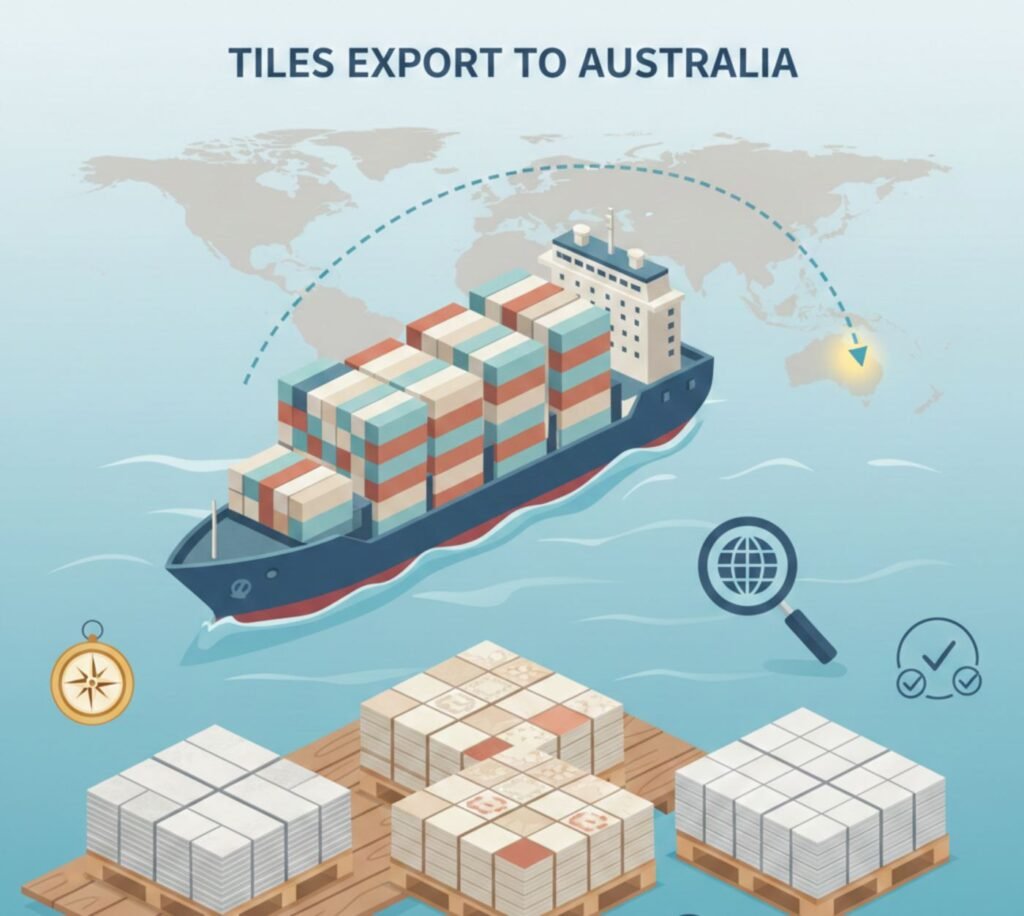
Australia’s tile market is booming again, and tiles export to Australia has quietly become one of the most profitable opportunities for Indian manufacturers, importers and wholesale buyers. With 0% duty on ceramic and porcelain tiles from India under the India–Australia ECTA, importers can build strong margins while still offering competitive retail prices in every major Australian city.
Last updated to reflect current Australian import rules, duties, and compliance requirements.
This guide to tiles export to Australia, you’ll learn exactly how import duties work, which HS Codes to use, what certifications (like AS 4586 slip resistance) you must have, how much shipping really costs from Mundra to Melbourne or Sydney, and how India compares against China, Spain, Italy and Turkey on price and quality.
Whether you’re a retailer, project buyer, builder, or a new importer researching ceramic tiles Australia prices, this article will walk you step-by-step through the entire tiles export to Australia process, from FOB quotes to landed CIF cost calculations.
This guide breaks down everything importers and exporters must know, including:
 Import duties & HS Codes ECTA tariff benefits Shipping cost & transit times Popular Australian tile sizes & finishes Required certifications (AS 4586, ISO 13006, slip resistance tests) India vs China vs Spain vs Italy vs Turkey competitiveness FOB vs CIF pricing Buyer pain points & how to avoid costly rejections Step-by-step import process Current market trends & demand insights
Let’s dive into the most comprehensive export guide available online.
Table of Contents
-
Market Overview: Why Australia Is a Prime Tile Import Market
-
Import Duties & HS Codes for Tiles Export to Australia
-
ECTA Advantage: Why India Has 0% Duty While China Pays 5%
-
Popular Tile Sizes, Finishes & Design Trends in Australia
-
Required Certifications & Documents (AS 4586, ISO 13006)
-
Shipping Costs & Transit Times (Mundra → Melbourne/Sydney)
-
Buyer Pain Points & Quality Concerns (and How Indian Exporters Can Solve Them)
-
FOB vs CIF Pricing Examples
-
India vs China vs Spain vs Italy vs Turkey – Who Wins?
-
Complete Step-by-Step Process for Importing Tiles to Australia
-
Frequently Asked Questions
1. Market Overview: Why Tiles Export to Australia Is Booming
After two slow years, demand surged due to:
-
New housing starts
-
Commercial renovations
-
Outdoor/patio upgrades
-
Rising preference for porcelain over stone
Why Importers Prefer Overseas Tiles
Australia imports 70% of its tiles because:
Local manufacturing is expensive Consumers demand new designs every year Builders prefer low-maintenance porcelain tiles Importers can achieve 50%+ gross margins
This creates huge opportunities for Indian exporters offering quality porcelain, GVT, slabs, and stone-look tiles.
2. Import Duties & HS Codes for Tiles Export to Australia
HS Codes & Applicable Duties latest
HS 690721 – Glazed Porcelain Tiles (<0.5% absorption)
-
India: 0% duty (ECTA)
-
China: 5%
-
Spain/Italy/Turkey: 5%
HS 690722 – Ceramic/Stoneware (0.5–10%)
-
India: 0%
-
Others: 5%
HS 690723 – Earthenware/Wall Tiles (>10%)
-
India: 0%
-
Others: 5%
HS 6914 – Porcelain Slabs (1200×2400mm+)
-
India: 0%
-
China: 5% after 2024 tariff reversal
Why This Matters
Importers get 1.3–1.8% cost savings immediately when choosing India over China.
3. ECTA Advantage: Why India Has 0% Duty While China Pays 5%
The India-Australia ECTA (effective 29 Dec 2022) eliminated duty on 100% of ceramic tile HS codes for Indian exporters.
ECTA Highlights
-
0% duty on 6907.xx + 6914
-
Coverage: 96.4% of Indian exports
-
China lost tariff concessions in late 2024
-
No anti-dumping duty on Indian tiles
Strategic Impact for Importers
Lower landed cost No anti-dumping risk Lower dispute & compliance risk More stable pricing than Chinese supply chain
4. Popular Tile Sizes, Finishes & Current Trends in Australia
Top Tile Sizes by Market Share
-
600×600mm: 55% (declining)
-
600×1200mm: 25% (fastest growing, new residential standard)
-
1200×2400 slabs: 12% (luxury + fastest growth)
-
300×600mm wall tiles: 3%
-
800×800mm: Premium niche
Top Finishes in Demand
Micro-Tec / Soft-Grip (P4/P5 rated)
Highest demand due to indoor-outdoor seamless designs.
Matte & Textured
Non-glossy surfaces with warm tones — now preferred over glossy.
Stone-Look (Marble/Travertine/Limestone)
High volume, especially in beige, cream, and greige palettes.
Wood-Look Planks
Warm residential feel; replacing actual timber due to durability.
Large Format Slabs
Driven by: Kitchen splashbacks Benchtops Wall cladding
Trending Colors
-
Warm neutrals: beige, greige, cream
-
Earth tones: ochre, rust, sand
-
Black/charcoal for commercial
If you want to explore high-quality porcelain, GVT and vitrified tile options suitable for tiles export to Australia, check our complete product range here:
Porcelain & Vitrified Tiles Collection
5. Required Certifications & Documents for Importing Tiles to Australia
Australia has strict technical standards, especially for porcelain floor tiles.
AS 4586 – Slip Resistance Test Report (Mandatory)
Most critical certification for floor tiles.
-
Test Type: Pendulum slip resistance
-
Ratings: P0–P5
-
Minimum for indoor: P3
-
Outdoor/commercial: P4–P5
-
Cost: AUD $800–$1,200
-
Lead Time: 5–7 days
Water Absorption Test – AS ISO 10545.3
-
Porcelain: <0.5%
-
Ceramic: 0.5–10%
-
Wall tiles: >10%
-
Cost: AUD $600–$800
ISO 13006 / AS 4662 Certification
Ensures durability:
-
Dimensional accuracy
-
Surface quality
-
Mechanical strength
Breaking Strength Test – AS ISO 10545.4
Required for commercial projects.
Silica Content / MSDS (New 2024 requirement)
Due to engineered stone ban, low-silica materials are preferred.
Mandatory Export Documents
-
Commercial Invoice
-
Packing List
-
Bill of Lading
-
Certificate of Origin (for ECTA 0% duty)
-
Test Reports (AS 4586, absorption, breaking strength)
-
Quarantine declaration: ISPM 15 heat-treated pallets
Failure to follow pallet rules = AUD $800 fumigation penalty + 7-day delay.
For official information on the Australia–India Economic Cooperation and Trade Agreement (ECTA), you can refer to:
https://www.dfat.gov.au/trade/agreements/in-force/ecta
6. Shipping Costs & Transit Times (Mundra → Australia)
Direct Service (Maersk/MSC)
-
Transit: 18–22 days
Transshipment (Singapore/Colombo)
-
Transit: 30–45 days
-
Higher breakage risk
Container Rates
20ft Container
-
USD $1050–$1,850 (Approx)
-
Capacity: 900–1,300 sqm
40ft Container
-
USD $1800–$2600
-
(Not preferred due to weight limits)
Australian Port Costs
-
Customs clearance: AUD $400–$600
-
Inland trucking: AUD $300–$500
Major Australian Ports for Tiles
-
Melbourne
-
Sydney
-
Brisbane
-
Fremantle
7. Buyer Pain Points & Quality Concerns (With Solutions)
1. Bowing/Warpage in Large Format Tiles
Issue: Installers reject warped 600×1200 slabs.
Solution:
-
Flatness <0.2%
-
Reinforced packaging
-
Use calibrated kilns
2. Shade Variation Between Batches
Issue: Leads to returns & project delays.
Solution:
-
Pre-shipment photos
-
Batch documentation
-
Same-kiln manufacturing
3. Inconsistent Thickness
Issue: Grout misalignment, poor finish.
Solution:
-
Gauge check every 30 minutes
-
Maintain equipment calibration
4. Poor Slip Resistance (Failing AS 4586)
Solution:
-
Micro-texture glaze
-
Pre-shipment P-rating test
5. Breakage During Transit
Solution:
-
Edge guards
-
5-layer cartons
-
ISPM 15 pallets
-
Void filling
8. FOB vs CIF Pricing
Old buyer prefers to buy FOB and New buyers generally prefer to buy CIF.
9. India vs China vs Spain vs Italy vs Turkey – Who Wins?
China
-
Strength: Pricing
-
Weakness: 5% duty, inconsistent quality
-
Trend: Declining
Spain
-
Strength: Certifications, mid-premium
-
Weakness: Higher price (50–100% over India)
-
Trend: Steady
Italy
-
Strength: Premium design
-
Weakness: Too expensive (3–5× India)
-
Trend: Niche
Turkey
-
Strength: Competitive
-
Weakness: Lower perceived quality
-
Trend: Growing
India (2025 Winner) 0% duty High-volume porcelain capacity Ability to match European designs Lower price than Spain/Italy More reliable than China (post-tariff change)
10. Complete Step-by-Step Process for Importing Tiles to Australia
Step 1: Select the Tile Type & Confirm Specs
-
Size
-
Thickness
-
Water absorption
-
P-rating
Step 2: Request Samples
Preferably AS 4586-tested samples.
Step 3: Get Quotations (FOB/CIF)
Compare:
-
Price
-
Packaging
-
Lead time
Step 4: Confirm Order + Advance Payment
Standard: 30% advance, 70% before container loading.
Step 5: Production & QC
-
Shade approval
-
Size checks
-
Warpage test
Step 6: Lab Testing (If Required)
AS 4586, ISO 10545, Breaking Strength.
Step 7: Packing & Palletization (ISPM 15 Mandatory)
Step 8: Export Documentation
-
Invoice
-
Packing list
-
COO (for ECTA 0% duty)
-
Test reports
Step 9: Shipping (18–22 days)
Step 10: Customs Clearance at Australian Port
Step 11: Inland Transport to Warehouse/Site
To work with a reliable Indian flooring exporter specializing in tiles export to Australia, you can visit our company page here:
Indian Flooring Exporter – Scalane International
11. Frequently Asked Questions (People Also Ask)
Q1: How much do ceramic tiles cost per square meter in Australia?
Retail ranges from $25–$120+/sqm depending on size and finish.
Q2: Is it cheaper to import tiles from India?
Yes — 0% duty, lower FOB rates, and better supply reliability.
Q3: What slip resistance rating do I need?
-
Indoor: P3
-
Outdoor: P4–P5
Q4: Are large format tiles worth it?
Yes — fewer grout lines, premium look, trending currently.
Q5: What documents are required to import tiles to Australia?
COO, Invoice, Packing List, B/L, ISPM 15 declaration, AS test reports.
Call-to-Action
If you’re an importer, retailer, or project buyer in Australia looking for high-quality porcelain, slabs, or GVT tiles at 0% duty, we can help.
Get FOB/CIF pricing, samples, Contact us for a detailed quote.
Phone: +91 9408897009
Email: exports@scalaneinternational.com