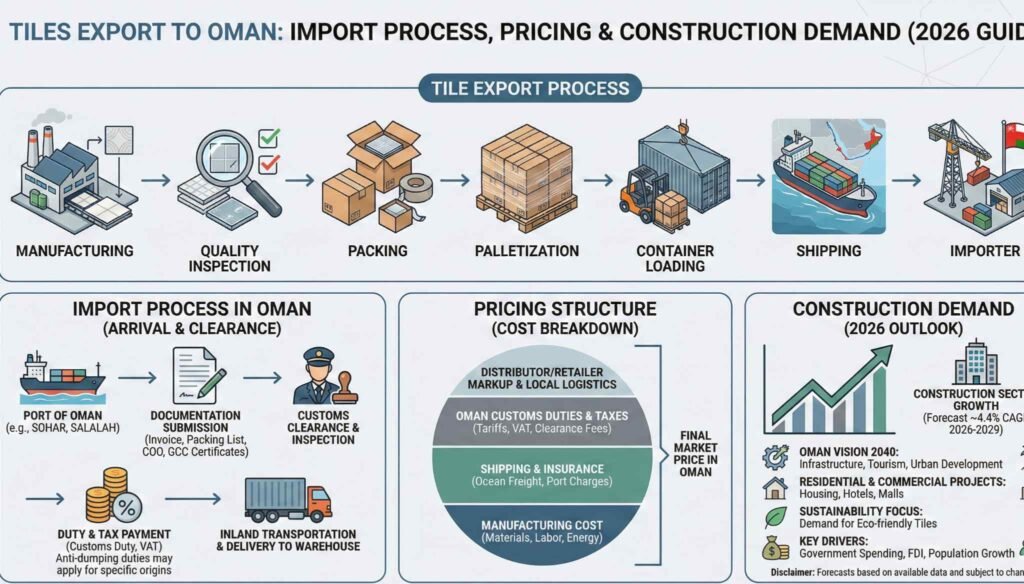
The Oman construction sector is entering a decisive growth phase. Large-scale residential developments, tourism-led commercial projects, and government-backed infrastructure investments are accelerating toward 2026, driving steady demand for ceramic, porcelain, vitrified, and large-format tiles.
For tile manufacturers, exporters, distributors, and project buyers, Oman represents a strategically important GCC market. Success here requires a clear understanding of import regulations, compliance standards, logistics planning, and buyer expectations.
This guide provides a complete, exporter-focused overview of tiles export to Oman, covering the import process, compliance requirements, structural pricing factors, construction demand outlook, and how buyers evaluate reliable tile suppliers in 2026.
Tiles Export to Oman: Market Overview & Opportunities (2026)
Oman’s construction industry is transitioning from short-term recovery to long-term, planned growth. Government-backed urban development, infrastructure expansion, and tourism investments are driving sustained demand for building materials, particularly tiles used in flooring, wall cladding, and exterior applications.
Why Oman Is a Strategic Market for Tile Exporters
Several structural factors make Oman an attractive destination for tile exports:
- Continued investment in housing, hospitality, and public infrastructure
- Strong preference for durable, low-maintenance porcelain and vitrified tiles
- Growing adoption of large-format tiles in commercial and premium residential projects
- Alignment with GCC construction standards, allowing regional scalability for exporters
Unlike saturated markets, Oman offers room for new supplier relationships—provided exporters meet regulatory and quality expectations.
Construction Demand Segmentation
Tile consumption in Oman spans three major segments:
Residential construction: Government housing programs and private developments drive steady demand for ceramic and porcelain tiles in bathrooms, kitchens, living areas, and corridors.
Commercial and hospitality projects: Hotels, resorts, shopping centers, and office buildings demand high-performance tiles with aesthetic consistency and durability.
Infrastructure and public sector buildings: Airports, transport hubs, hospitals, and educational facilities require tiles that meet strict safety, hygiene, and performance standards.
Ceramic & Porcelain Tile Import Regulations in Oman
Understanding Oman’s import framework is essential for exporters and importers. Oman follows the unified GCC customs structure, with additional country-specific compliance requirements.
HS Codes & Import Classification
Ceramic and porcelain tiles are imported under specific HS codes depending on glazing and application:
- Unglazed ceramic tiles
- Glazed ceramic and porcelain tiles for floor and wall use
Accurate HS classification is critical. Incorrect declaration can result in customs delays, reassessments, or penalties during clearance.
Import Duties & Anti-Dumping Compliance (Critical Update)
Oman applies standard customs duties on tile imports based on CIF value. However, a significant regulatory change has reshaped the competitive landscape:
- Anti-dumping duties are enforced on ceramic and porcelain tiles originating from certain countries following a GCC investigation concluded in 2025
- These duties apply across all Omani entry points—sea, land, and air
For importers and exporters, this has shifted sourcing strategies toward compliant suppliers with transparent documentation and strong quality credentials.
Who Can Import Tiles in Oman
Tiles can only be imported by entities that meet Oman’s commercial requirements:
- Valid commercial registration
- Active industrial or trading license
- Membership with the Oman Chamber of Commerce and Industry
Exporters typically work with licensed Omani importers or distributors who handle local customs clearance and inland distribution.
Mandatory Standards & Certifications for Tile Imports
Compliance is non-negotiable in Oman’s building materials sector. Tiles that fail to meet standards face rejection or re-export.
Technical Standards Required
All ceramic and porcelain tiles imported into Oman must comply with ISO 13006:2018, which governs:
- Classification by water absorption
- Dimensional tolerances
- Mechanical strength and breaking load
- Surface quality and performance characteristics
This standard applies across residential, commercial, and industrial applications.
Testing & Laboratory Compliance
Compliance must be supported by testing conducted in ISO/IEC 17025-accredited laboratories. Importers and customs authorities expect:
- Valid test reports linked to specific product batches
- Consistency between samples, production batches, and shipped goods
- Clear documentation of water absorption, slip resistance, and durability
Export Documentation Checklist
A complete tile export shipment to Oman typically includes:
- Certificate of Origin (properly legalized)
- Commercial invoice and detailed packing list
- Bill of Lading or Air Waybill
- Manufacturer’s certificate and quality declaration
- ISO 13006 test reports from accredited labs
- HS code classification documents
- Shipment insurance papers
Incomplete or inconsistent documentation is one of the most common causes of customs delays.
Tile Specifications Preferred by Omani Buyers
Buyer preferences in Oman are shaped by climate, usage intensity, and long-term performance expectations.
Popular Tile Sizes & Thickness
Demand varies by application:
- Standard floor tiles: 600×600mm remains the most versatile and widely used size
- Wall and mixed-use tiles: 300×600mm and 600×1200mm are common in residential projects
- Large-format tiles: Increasingly used in commercial spaces and premium homes
- Thickness: Ranges from standard wall tiles to heavy-duty outdoor and industrial tiles
Surface Finishes & Applications
Omani buyers evaluate tiles based on both aesthetics and functionality:
- Glazed tiles dominate residential interiors due to design variety and water resistance
- Unglazed and matte finishes are preferred in commercial and outdoor areas for slip resistance
- Stone-look, wood-look, and textured surfaces are popular for modern architectural designs
Use-Case Mapping
Tiles are selected based on performance requirements:
- Residential: Bathrooms, kitchens, living spaces
- Commercial: Hotels, malls, offices, healthcare facilities
- Industrial and outdoor: Factory floors, walkways, terraces
ISO ceramic tile standards
How Tile Pricing Is Structurally Determined
Professional importers focus on cost structure, not just unit cost. Understanding these factors helps buyers make informed decisions.
Manufacturing & Material Variables
Key production-related factors include:
- Quality and sourcing of raw materials
- Manufacturing technology (pressed vs. extruded)
- Tile size, thickness, and surface treatment
- Design complexity and digital printing
Logistics & Compliance Cost Drivers
Export-related costs are influenced by:
- Export-grade packaging and breakage prevention
- Certification, testing, and inspection requirements
- Container utilization efficiency and shipping methods
Why Buyers Compare More Than Price
Experienced importers evaluate:
- Lifecycle performance and durability
- Risk of defects and replacements
- Supplier reliability for repeat orders
- Documentation accuracy and compliance history
Shipping, Logistics & Customs Clearance in Oman
Tiles are heavy, fragile, and volume-driven—making logistics planning critical to successful exports.
Main Entry Ports & Logistics Flow
Most tile shipments enter Oman through Port of Sohar, supported by other regional ports. From there, goods move via road networks to major cities and project sites.
Packaging & Damage Prevention
Professional exporters follow strict packing protocols:
- Moisture-resistant pallets and crates
- Edge protection and secure stacking
- Shrink wrapping and container optimization
Typical Lead Time Breakdown
A standard export cycle includes:
- Manufacturing and finishing
- Quality inspection and testing
- Documentation preparation
- Sea freight transit
- Customs clearance and inland delivery
What Omani Tile Importers Expect from Exporters
Buyer expectations in Oman are high and clearly defined. Meeting these standards is essential for long-term partnerships.
Quality & Consistency Expectations
Importers expect:
- Uniform size, color, and finish within each batch
- Zero tolerance for cracks, warping, or glaze defects
- Performance matching declared specifications
Documentation & Communication Standards
Trust is built through:
- Accurate, complete paperwork
- Fast and clear communication
- Demonstrated export experience to GCC markets
Risk Factors Buyers Actively Avoid
- Certification gaps or expired test reports
- Inconsistent production batches
- Unreliable delivery schedules
How to Evaluate a Reliable Tile Exporter
Before placing bulk orders, importers conduct structured due diligence. Here’s what matters most.
Supplier Due Diligence Checklist
Key evaluation points include:
- Manufacturing capacity and quality control systems
- Export history and destination markets served
- Compliance with international standards
Sample Testing & Approval Process
Professional buyers insist on:
- Physical samples matching production batches
- Third-party laboratory testing when required
- Pre-shipment inspections for large orders
Why Scalane International Is a Trusted Tile Export Partner
Scalane International operates as a dedicated Indian exporter of ceramic, porcelain, vitrified, GVT, and PGVT tiles, serving importers, distributors, and project buyers across global markets.
Export Experience & Market Focus
- Structured B2B export operations
- Experience serving GCC and Middle East buyers
- Familiarity with Oman-specific documentation and compliance
Quality Assurance & Compliance Strength
- Products aligned with ISO 13006 requirements
- Testing through accredited laboratories
- Consistent batch control and export-grade packing
Logistics & Buyer Support Capabilities
- Export-ready documentation processes
- Coordinated logistics and shipping support
- Clear communication throughout the order cycle
Scalane International focuses on long-term partnerships built on reliability, compliance, and consistent supply rather than short-term transactions.
Frequently Asked Questions About Tile Importing to Oman
What documents are required to import tiles into Oman?
A complete set includes Certificate of Origin, invoice, packing list, Bill of Lading, test reports, and importer registration documents.
Are porcelain tiles better than ceramic tiles for Oman?
Porcelain tiles are often preferred for high-traffic and commercial applications due to their durability and low water absorption.
How can buyers verify tile quality before shipment?
Through sample approval, ISO-compliant test reports, and third-party inspections.
What causes most customs delays for tile imports?
Incorrect HS codes, incomplete documentation, or missing compliance certificates.
Request Tiles for Oman Projects (Next Steps)
If you’re sourcing tiles for Oman’s residential, commercial, or infrastructure projects, the next steps typically include product evaluation and technical review.
Request a Detailed Product Catalogue
Explore available ceramic, porcelain, vitrified, GVT, and PGVT tile ranges.
Request Samples for Testing & Approval
Evaluate quality, finish, and performance before bulk ordering.
Request a Project-Based Quotation
Receive a structured quotation aligned with your specifications and compliance needs.
For export-ready tile solutions backed by documentation, quality assurance, and international experience, connect with Scalane International through www.scalaneinternational.com.