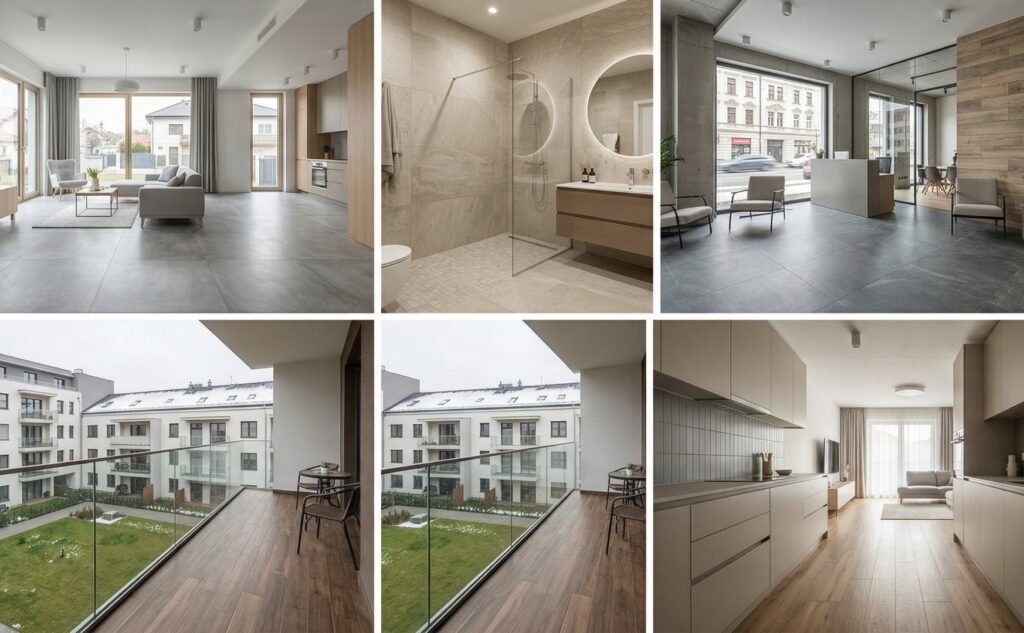
Tiles Export to Slovakia from India – Definition
Exporting tiles from India to Slovakia means supplying CE-certified ceramic, porcelain, vitrified, and GVT tiles that fully meet European Union standards. Given Slovakia’s cold continental climate, every product in this category must be engineered for frost resistance and low water absorption — these are non-negotiable requirements, not optional features.
From a compliance standpoint, all tiles exported to Slovakia must conform to EN 14411, adhere to CPR 2024/3110, and satisfy REACH regulations. Delivery typically routes through established EU ports — Koper, Hamburg, or Rotterdam — followed by inland logistics into Slovakia. Complete documentation accompanies every shipment, including a Declaration of Performance (DoP), CE marking, and third-party lab test reports.
Slovakia Tile Market Overview
Slovakia’s construction sector is growing steadily, with the tile market expanding at approximately 4.2% CAGR. Demand is concentrated in durable, high-performance formats — particularly porcelain and vitrified tiles — driven largely by residential renovation activity, apartment upgrades, and a rising number of Build-to-Rent (BTR) projects requiring bulk tile supply.
Key urban markets include Bratislava, Košice, Žilina, Trnava, and Nitra. Outdoor tile demand is especially strong because of the country’s freeze-thaw climate, which makes anti-slip and frost-resistant specifications essential rather than preferred.
In terms of aesthetics, wood-look, concrete-finish, stone-texture, and neutral-tone tiles are consistently popular across both residential and commercial segments.
Types of Tiles Exported to Slovakia
Ceramic Tiles Ceramic tiles serve wall applications and lighter-use interior areas well. They remain a practical, cost-effective choice for renovation projects where budget efficiency is a priority.
Porcelain Tiles Porcelain is the most preferred tile format in the Slovak market — and for good reason. With water absorption below 0.5%, high frost resistance, and suitability for both indoor and outdoor use, porcelain tiles are purpose-built for Slovakia’s climate and construction demands.
Vitrified Tiles Vitrified tiles combine exceptional strength with long-term durability, making them the go-to choice for high-traffic commercial and residential flooring applications.
GVT / PGVT Tiles Glazed Vitrified Tiles and Polished Glazed Vitrified Tiles bring high-definition surface designs to modern interiors. Increasingly popular in both residential and commercial projects, they offer a competitive design alternative to tiles traditionally sourced from Spain or Italy.
Why Slovakia Imports Tiles from India
Indian tile manufacturers offer a well-established combination of competitive value and production quality that is difficult to match in the EU tile supply chain. Key advantages include large-scale manufacturing capacity suited to bulk orders, strong expertise in GVT and porcelain tile production, flexibility for custom specifications, and growing alignment with EU compliance requirements. For Slovak buyers seeking consistent quality at scale, India has become a reliable sourcing destination.
EU Compliance & Standards for Slovakia
Mandatory Standards All tiles exported to Slovakia must carry CE Marking, comply with EN 14411, and conform to the EU Construction Products Regulation (CPR 2024/3110).
Technical Requirements Frost resistance is mandatory for any tile intended for outdoor use in Slovakia. Porcelain tiles must achieve water absorption below 0.5%. Slip resistance ratings — R9 to R13 per DIN 51130, and A, B, C per DIN 51097 — are required depending on application.
Environmental Compliance Products must comply with REACH regulations, maintain low VOC levels, and be prepared for Global Warming Potential (GWP) declarations, which become a formal requirement from 2026. Digital Product Passport readiness is also increasingly expected by EU buyers.
Documentation Every shipment requires a Declaration of Performance (DoP), CE Certificate, third-party lab test reports, and full shipping documentation.
Logistics & Shipping to Slovakia
Shipping Routes Three primary sea routes connect Indian tile manufacturers to Slovakia:
-
- India → Koper (Slovenia) → Slovakia
-
- India → Hamburg (Germany) → Slovakia
-
- India → Rotterdam (Netherlands) → Slovakia
Transit Time Sea freight takes 25–35 days. Inland transport from port to delivery point typically adds 2–5 days.
Inland Transport Both road freight and rail are used for inland delivery, with rail preferred for large-volume bulk shipments.
Key Advantage The Koper port route is generally the fastest and most efficient option for reaching Slovakia, offering a meaningful logistics advantage over the longer northern European port alternatives.
Packaging & Quality Assurance
Every shipment is packed in reinforced export cartons with EU-compliant labeling. Euro palletization and shrink wrapping protect against transit damage, while edge protection reduces breakage risk. Moisture-resistant packaging ensures product integrity across long sea voyages.
On the quality side, pre-shipment inspection, third-party testing, and strict batch consistency checks — covering both shade and dimensional sizing — are standard practice. QR-based documentation access is also provided, making it easy for buyers to verify certifications on arrival.
Buyer Decision Factors in Slovakia
Slovak buyers prioritize a specific set of criteria when sourcing tiles internationally. Frost resistance tops the list, followed by overall durability in cold-climate conditions, consistent sizing and surface finish, reliable delivery timelines, transparent EU compliance documentation, and confidence in long-term supplier reliability. Suppliers who can demonstrate strength across all these factors are well positioned to build lasting relationships in this market.
Competitive Comparison
| Country | Strength | Weakness |
|---|---|---|
| India | Price-quality balance, GVT strength | Compliance perception |
| Poland | EU compliance, pricing | Limited design range |
| Czech Republic | Fast delivery | Higher cost |
| Spain | Premium design | Expensive |
| Turkey | Competitive pricing | Quality perception |
| China | Low cost | Trust issues |
| EU (other) | Logistics advantage | High cost |
Why Choose Scalane International
Scalane International brings focused export experience to the European tile market, with particular expertise in porcelain, vitrified, and GVT tiles. The company combines strong EU compliance knowledge — covering EN 14411, CPR, and CE certification requirements — with reliable logistics management and bulk supply capability. For Slovak buyers, this translates into a supplier that understands both the technical expectations of the EU market and the operational demands of large-scale procurement.
About Scalane International
Scalane International is an India-based tile exporter serving construction and infrastructure sectors across global markets. With proven export capability into the EU (Croatia, Ireland) and a thorough understanding of Slovakia’s specific market requirements, the company supports buyers from product selection through to final delivery.
Trust & Reliability Scalane International’s exports are CE-certified and supported by verified documentation, including Declarations of Performance and third-party lab reports. Robust packaging standards minimize in-transit damage, and consistent product quality is maintained across all shipment batches.
E-E-A-T
-
- Experience: Active exporting to EU markets
-
- Expertise: Full EU compliance capability — EN 14411, CPR, REACH
-
- Authority: Specialist in GVT and porcelain tile supply
-
- Trust: Certified quality, consistent documentation, and reliable logistics
FAQs – Tiles Export to Slovakia
Can tiles be imported to Slovakia from India? Yes. Indian tiles can be legally exported to Slovakia provided they carry CE marking, comply with EN 14411, and are supported by the required EU documentation.
What EU regulations apply to tile imports into Slovakia? Tiles must comply with CPR 2024/3110, applicable EN standards, and REACH environmental regulations.
Is CE marking mandatory? Yes. CE marking is a legal requirement for all tiles exported to and sold within Slovakia and the broader EU market.
What is EN 14411? EN 14411 is the European standard that defines the quality, durability, and performance requirements for ceramic tiles, including porcelain.
What documents are required for tile exports to Slovakia? The standard documentation set includes a Declaration of Performance (DoP), CE Certificate, third-party lab test reports, and full shipping documents.
How are tiles shipped to Slovakia? Shipments travel by sea to EU entry ports — primarily Koper, Hamburg, or Rotterdam — and then move inland to Slovakia by road or rail.
What is the typical shipping time? Sea freight takes 25–35 days, with inland delivery adding another 2–5 days depending on the destination city.
Why is frost resistance so important for Slovakia? Slovakia experiences significant freeze-thaw cycles throughout the year. Tiles used outdoors must withstand these conditions without cracking, lifting, or deteriorating.
Which tile types are best suited to the Slovak market? Porcelain and vitrified tiles are the most appropriate formats given Slovakia’s climate and construction standards.
What slip resistance ratings are required? R9–R13 (DIN 51130) for dry and wet floor applications, and A, B, C ratings (DIN 51097) for wet barefoot areas such as pool surrounds and changing rooms.
How should buyers evaluate a tile supplier for Slovakia? Key factors to assess include EU compliance credentials, product quality consistency, export experience into European markets, and the ability to deliver reliably at the required volumes.
What packaging standards apply? Export-grade cartons, Euro palletization, shrink wrapping, and edge protection are the baseline requirements for tiles shipped to Slovakia.
Are Indian tiles EU compliant? Yes, provided the manufacturer has obtained the necessary certifications and product testing from accredited laboratories.
What factors most influence purchasing decisions in Slovakia? Frost resistance, long-term durability, dimensional consistency, EU compliance transparency, and supplier reliability are the primary considerations for Slovak buyers.
Is specialist installation required? Yes. Outdoor tile installations in Slovakia should use frost-resistant adhesives and follow installation methods appropriate for freeze-thaw environments.
Final CTA – Start Your Tile Import to Slovakia
-
- Request product catalog tailored for Slovakia
-
- Get CE-certified samples
-
- Discuss bulk project requirements
-
- Receive full EU compliance documentation
 Contact Scalane International Now for Bulk Tile Export to Slovakia