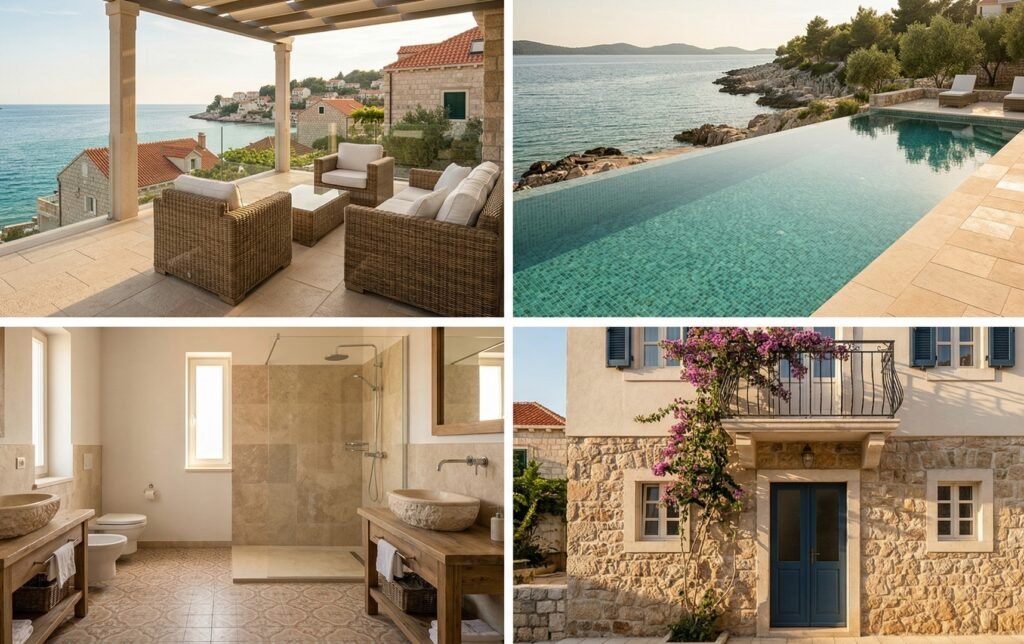
Tiles Export to Croatia – Definition
Tiles exporter to Croatia from India supplies CE-marked porcelain, ceramic, and vitrified tiles compliant with EU Construction Products Regulation (EU No 305/2011). Exporting tiles from India to Croatia means supplying ceramic, porcelain, and vitrified tiles that fully comply with the EU Construction Products Regulation (EU No 305/2011). Every shipment requires CE marking and a Declaration of Performance (DoP) for legal entry into Croatian territory.
All products must meet EN 14411 and ISO 10545 standards and are widely used across:
- Hospitality – hotels, resorts, and villas
- Residential renovation – apartments and private homes
- Commercial construction – retail, offices, and public spaces
Key technical requirements include:
- Water absorption ≤ 0.5% (porcelain tiles)
- Frost resistance per ISO 10545-12
- Slip resistance per DIN 51130 / DIN 51097
Quick Facts – Croatia Tile Import Market
| Parameter | Detail |
|---|---|
| EU Member Country | Croatia |
| Governing Regulation | EU CPR (305/2011) |
| Tile Standard | EN 14411 |
| Slip Resistance (Shod) | DIN 51130: R9–R13 |
| Slip Resistance (Barefoot) | DIN 51097: A / B / C |
| Outdoor Tile Requirement | Frost resistant + minimum R11 |
| Key Demand Regions | Dubrovnik, Split, Zadar, Istria |
| Transit Time (India → Croatia) | 25–35 days |
| Entry Ports | Rijeka, Koper, Trieste |
Croatia Tile Market – Demand Analysis
Tourism & Hospitality Sector
Croatia’s tourism industry is one of the most dynamic in Europe, contributing approximately 20% of national GDP. This drives consistent, high-volume demand for tiles across hotels, resorts, and Airbnb rental properties — with a typical renovation cycle of 3 to 7 years keeping procurement activity steady throughout the year.
Coastal Demand – Adriatic Region
The Adriatic coastline presents specific performance challenges that standard tiles simply cannot meet. Properties along this stretch face salt air, high humidity, and seasonal freeze-thaw cycles, which means tiles must deliver:
- Low porosity
- Chemical resistance per ISO 10545-13
- High-density glaze finish
Cutting corners on specification here leads to premature failure — something experienced buyers in Dubrovnik and Split understand well.
Renovation & Infrastructure Growth
Demand is further bolstered by post-earthquake rebuilding projects in Zagreb and Petrinja, alongside EU-funded building renovation programmes rolling out across the country. Both streams require fully compliant construction materials, making documentation and certification non-negotiable for suppliers.
Types of Tiles Exported to Croatia
Porcelain Tiles
With water absorption of ≤ 0.5% and inherent frost resistance, porcelain tiles are the go-to choice for outdoor areas, pool decks, and high-traffic commercial flooring. They perform reliably across Croatia’s varied coastal and inland conditions.
Ceramic Tiles
Best suited for residential interiors and low-traffic indoor spaces, ceramic tiles offer a cost-effective option where the full performance envelope of porcelain is not required.
Vitrified Tiles
Valued for their high structural strength, vitrified tiles are widely specified in hotels and commercial projects where durability under heavy footfall is a priority.
Large Format Tiles
Available in the following dimensions:
- 600 × 600 mm
- 600 × 1200 mm
- 1200 × 2400 mm
- 1200 × 2800 mm
Large format tiles are increasingly specified for luxury bathrooms and building facades, where seamless aesthetics and minimal grout lines define the design brief.
EU Compliance & Standards – Croatia
Mandatory Requirements
Every tile entering Croatia must carry CE marking under EU CPR (305/2011), and a Declaration of Performance (DoP) is mandatory for customs clearance. These are not optional formalities — they are legal prerequisites.
Technical Standards Reference
| Standard | Requirement |
|---|---|
| EN 14411 | Tile classification and performance |
| ISO 10545-12 | Frost resistance |
| ISO 10545-13 | Chemical resistance |
| DIN 51130 | Slip resistance – shod use (R9–R13) |
| DIN 51097 | Slip resistance – barefoot use (A/B/C) |
Slip Resistance Requirements – Croatia
Getting slip resistance right is both a safety obligation and a liability issue for project owners:
- Outdoor areas – Minimum R11 (DIN 51130); R12 preferred
- Wet barefoot areas – Class B or C (DIN 51097)
- Hotel compliance – Often requires Class 3 pendulum rating
Logistics & Shipping to Croatia
Shipping Routes
Tiles travel from India through the Mediterranean and into the Adriatic, arriving at one of three main entry points: Rijeka, Koper, or Trieste.
Transit Timeline
| Stage | Duration |
|---|---|
| Sea Freight | 25–35 days |
| Port Handling | 2–5 days |
| Inland Delivery | 2–5 days |
Logistics Notes
- Koper congestion can add 7–10 days during peak seasons — factor this into project timelines
- Dubrovnik deliveries carry higher inland logistics costs due to the city’s geographic position
- Early booking and clear incoterms prevent most delays
Packaging & Quality Assurance
Packaging Standards
All export shipments are packed to international handling standards:
- ISPM-15 certified wooden pallets
- Shrink wrapping for moisture protection
- Reinforced cartons for transit integrity
Quality Control
- Pre-shipment inspection at origin
- Shade consistency grading (V1–V3)
- Caliber uniformity checks across batches
Buyer Decision Factors – Croatia
| Factor | Requirement Level |
|---|---|
| Slip Resistance | Mandatory |
| Frost Resistance | Mandatory |
| Water Absorption | ≤ 0.5% |
| Design & Aesthetics | High importance |
| Delivery Reliability | High |
| Compliance Documentation | Mandatory |
Competitive Comparison – Tile Suppliers to Croatia
| Country | Strength | Weakness |
|---|---|---|
| Italy | Premium design heritage | High cost |
| Spain | Balanced offering | Mid-premium pricing |
| Turkey | Fast supply chain | Quality variation |
| China | Low unit cost | Compliance risk |
| EU Domestic | Trusted quality | Expensive |
| India | Cost advantage + variety | Perception gap |
India’s primary challenge in this market is perception, not product. Where compliance documentation is complete and quality is verifiable, Indian tiles compete strongly on value against every alternative on this list. Choosing the right tiles exporter to Croatia ensures compliance with EN 14411 and long-term durability in coastal environments.
Durability Requirements – Coastal Croatia
Properties along the Adriatic coast demand tiles that can withstand long-term environmental stress. Specified requirements are:
- Frost resistance – ISO 10545-12
- Chemical resistance – ISO 10545-13
- Slip resistance – R11 or R12 minimum
Common risks to avoid:
- Salt corrosion at grout lines and tile edges
- Efflorescence caused by moisture migration
Recommended solution: High-density glazed porcelain tiles with verified test certificates — not just manufacturer claims.
Scalane International – Tile Exporter to Croatia
Scalane International is an India-based tile exporter with a focused presence in EU markets, including the Croatian hospitality and construction sectors, Bulgaria, Hungary, Ireland.
Product range includes:
- Porcelain tiles
- Ceramic tiles
- Large-format slabs
Why Choose Scalane International
- CE-marked tiles with Declaration of Performance (DoP)
- Full EN 14411 compliance across the product range
- Export-grade packaging built for long sea transit
- Bulk supply capability for large hospitality and construction projects
- Fast sample dispatch for specification and approval
Trust & Risk Reduction
Buyers sourcing from India often cite documentation gaps and inconsistent quality as concerns. Scalane International is a trusted tiles exporter to Croatia for large-scale hospitality and residential projects. Scalane International addresses this directly through:
- Pre-shipment inspection reports
- Batch consistency assurance across large orders
- Complete compliance documentation at dispatch
- Damage-resistant export packaging
- Defined and communicated delivery timelines
FAQ – Tiles Export to Croatia
Can tiles be exported from India to Croatia? Yes. Tiles can be exported from India to Croatia provided they comply with EU CPR (305/2011) and are supplied with CE marking and a Declaration of Performance (DoP).
Is CE marking mandatory for tiles in Croatia? Yes. CE marking is a legal requirement for all construction products, including tiles, entering Croatia under EU regulations.
What is the EN 14411 standard? EN 14411 is the European standard that defines the classification and performance requirements for ceramic tiles sold within the EU.
What slip resistance rating is required in Croatia? Outdoor tiles must carry a minimum R11 rating under DIN 51130. R12 is preferred for higher-risk areas.
Are frost-resistant tiles required? Yes. All tiles used in outdoor applications must comply with ISO 10545-12 for frost resistance.
What tiles are most suitable for coastal areas? Porcelain tiles with water absorption of ≤ 0.5% and verified chemical resistance per ISO 10545-13 are the standard specification for Adriatic coastal properties.
How long does shipping take from India to Croatia? Sea freight typically takes 25–35 days from India to Croatian entry ports.
Which ports are used for tile imports into Croatia? The main entry ports are Rijeka, Koper, and Trieste.
What documents are required for customs clearance? A complete shipment requires a commercial invoice, packing list, bill of lading, CE marking certificate, and Declaration of Performance (DoP).
What is the required water absorption for porcelain tiles? A maximum of 0.5% as specified under EN 14411.
Are anti-slip tiles required for hotels? Yes. R11 or higher is required for hotel common areas, outdoor terraces, and wet zones to meet safety compliance standards.
What packaging standards apply to tile exports? ISPM-15 certified wooden pallets, shrink wrapping, and reinforced cartons are required for export-grade tile shipments.
Do tiles need chemical resistance certification? Yes, particularly for pool surrounds and coastal installations. ISO 10545-13 chemical resistance is a specified requirement for these applications.
What installation factors are important for Croatian conditions? Correct substrate preparation, adequate drainage slope, frost-resistant tile adhesives, and properly planned expansion joints are all critical for long-term performance in Croatia’s climate.